Call Garreth, Cameron & CallyAI: 0115 9893488

FREE UK shipping on orders over £100.00 & FREE gifts on checkout

Useful Links
Your Account

Talk to us

Garreth, Cameron & CallyAI · Mon to Fri
Call 0115 989 3488Free advice on your build
Thanks, that’s with us. We reply the same working day.
That didn’t send. Please give us a call instead.

Useful Links

Quick Access

Want to chat?

Call Garreth, Cameron, CallyAI
Today On: 0115 9893488
Click Here For Our Contact Form


The Top 10 Three Point Road Harnesses, And How They Go In

Three point road harnesses

A three point harness is what you end up with when you want a proper belt in a car that has nowhere to hang one. No cage. No harness bar, nothing behind the seats but a rear bench, and a four point wanting two anchorages back there that are simply not in the car.

Cameron gets asked for a four point about three times as often as a three point, and talks most of them out of it. Not because a four point is worse. Because a four point bolted to whatever was convenient is worse than the seatbelt it replaced, and on a standard bodyshell convenient is usually all there is.

Garreth is blunter. He has turned down four point sales before now, on cars where the only place to put the top mounts was somewhere he was not willing to put them.

  • Three points means ONE upper anchorage that both shoulder straps share, plus two at the hips
  • That single upper point is why it fits a car with no cage and no harness bar behind the seats
  • Most road cars already have all three, because the factory belt uses the same ones
  • The anchorage thread is 7/16in UNF, the same the world over
  • ECE R16 is the belt approval and carries a circle E mark. ECE Regulation 14 is the anchorage
  • Shoulder straps run no more than 45 degrees below horizontal, and never upward
  • A harness is never anchored to the seat, its runners or its subframe. Always to the car
  • We list 22 three point belts as singles, from £45.60 to £169.49 inc VAT
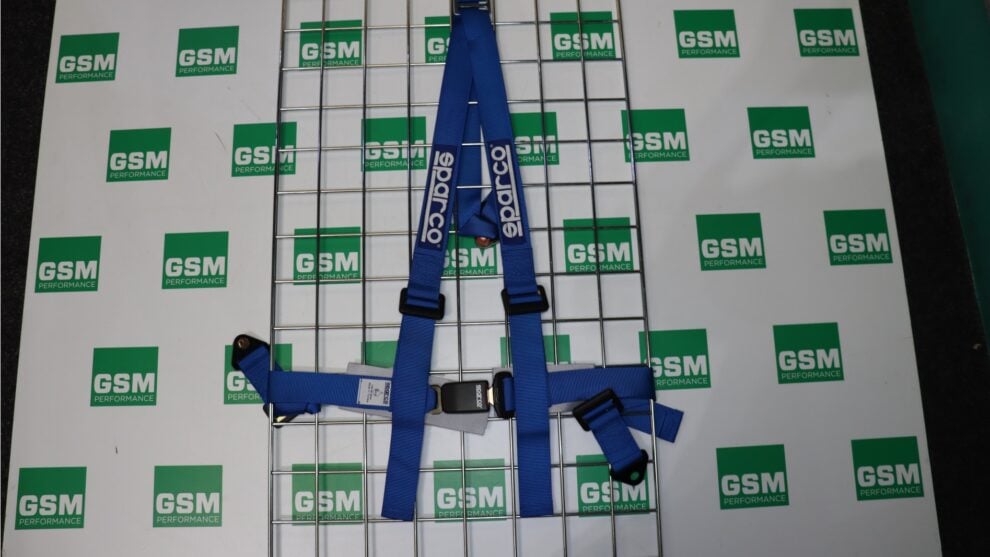
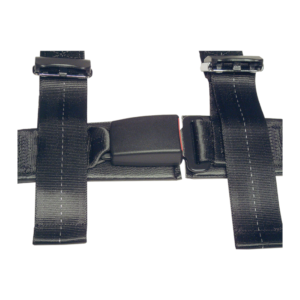
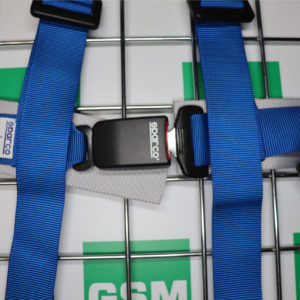
A Sparco Club H-3 three point road harness in blue on the GSM Performance display board, showing one tail strap splitting into two shoulder straps down to a push button buckle, with the lap belt running out to each side and nothing below the buckle
The Sparco Club H-3 on our own board. One strap at the top, two over the shoulders, a push button buckle, and the lap belt out to each side. Nothing runs below the buckle, and that is what makes it a three point and not a five or a six.

What a three point harness actually is

A three point harness is not a factory lap and diagonal with better webbing on it, whatever a lot of the internet and a fair few of our own product descriptions say.

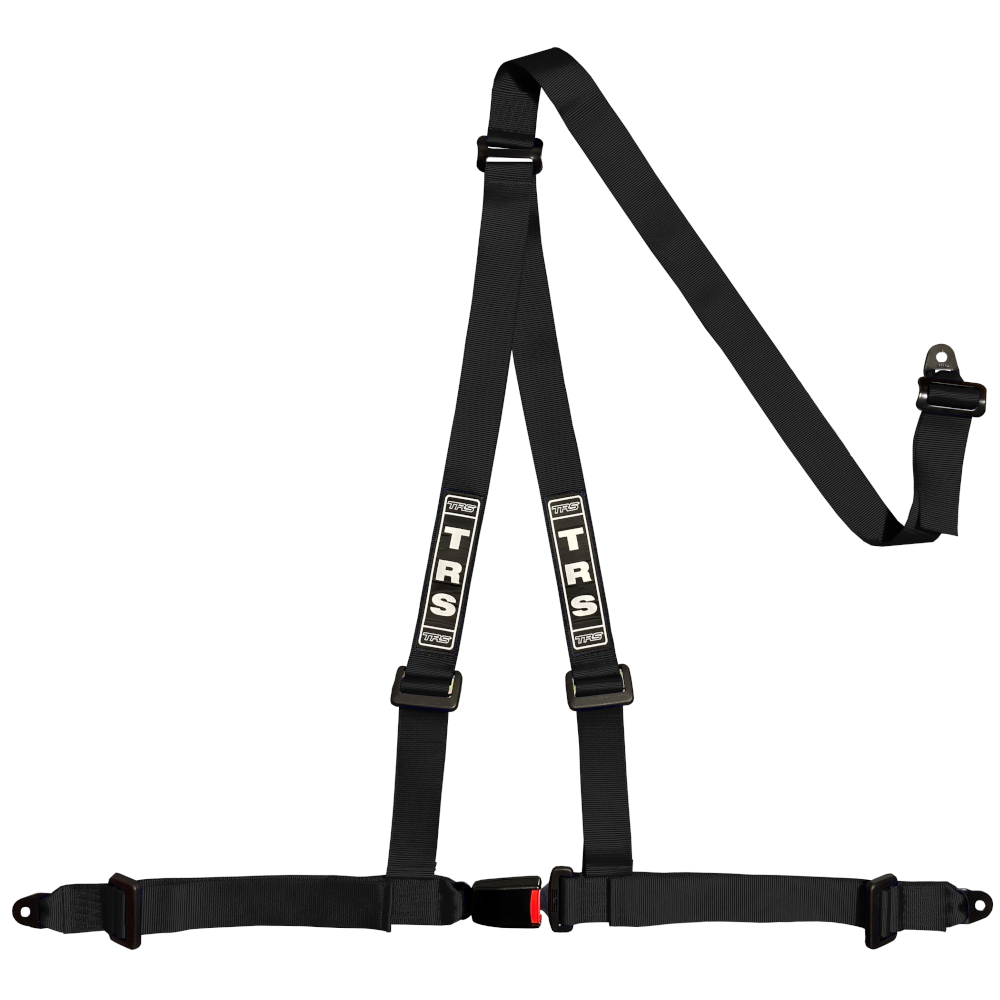
Two shoulder straps come over both shoulders, the same as they would on a four point, and then they merge into a single tail with one end fitting. Below that is a lap belt with an end each side. One anchorage up, two down.

So two straps hold your upper body, evenly, where a factory belt puts one strap across one shoulder.

How a three point harness lies on the seat

23harness slotsFROM THE FRONTone buckle takes both shoulder strapsand the lap beltshoulder height45 degrees, the limit13ONE anchorage,behind and belowthe shoulderlap beltpale = acrossyour chestFROM THE SIDE

Two elevations of the same thing. From the front, both shoulder straps come through the harness slots and meet one buckle on the cushion, with the lap belt out to each side. From the side, the pale strap is the part across your chest and the solid one is the tail running back to the single anchorage, which has to sit inside 45 degrees of horizontal. Schematic, and not a scale drawing of any particular seat.

Why the two straps share one anchorageBecause a road car has nowhere to put two. A four point needs an anchorage behind each shoulder, roughly at shoulder height, on something structural. On a bodyshell with a back seat in it, there is usually no such thing, which is how four point belts end up bolted to parcel shelves and seat frames. Bringing both straps to one point that does exist sidesteps the whole argument, and that is the job this type of belt was invented to do.

The ten we would pick first

Ranked on what we would actually reach for and not on price, across nine brands, with TRS appearing twice because their retractable answers a different question to everything else here.

HarnessBrandPrice inc VAT
1Schroth Rallye ASMSchroth£169.49
2TRS Clubman Bolt In 3 PointTRS£96.00
3Sparco Club H-3 Bolt InSparco£94.58
4OMP Road 3OMP£108.00
5Sabelt 3 Point Bolt In ClubmanSabelt£129.60
6Safety Devices 3 Point Bolt-InSafety Devices£63.79
7QMS ECE 3-PointQMS£99.00
8Auto Style Racing 3 PointAuto Style£87.40
9Corbeau 3-Point RetractableCorbeau£111.00
10TRS 3 Point Lap & Diagonal RetractableTRS£45.60

Live prices including VAT. Ring us on 0115 9893488 for current lead times on any of them.

A word on the Schroth. ASM stands for anti submarining, and it is a flap of webbing sewn into the inboard shoulder strap. Under load it tightens and stops your pelvis sliding forward underneath the lap belt.

Submarining is the failure a four point is worst at, because two shoulder straps pulling evenly lift the lap belt off your hips. Garreth brings this up a lot, usually to somebody who walked in wanting a four point.

Cameron lets him finish and then asks what the car is. Most people ringing up want a belt that holds them in a bucket seat on a track day and costs about a hundred pounds, and for that he reaches for the TRS Clubman.

Every three point we do, brand by brand

Twenty two belts across nine brands, as singles. Where a brand does the same belt in bolt in and clip in, both are listed, because the fitting usually decides more than the badge. Bolt in stays in the car. Clip in comes out without tools.

HarnessFittingWebbingColoursPrice inc VAT
Schroth
Rallye ASM 3 pointBolt in2in shoulder and lapBlack, blue, red, silver£169.49
TRS Motorsport
Clubman Bolt In 3 PointBolt in50mm, steel adjustersNine, including Miami blue£96.00
Clubman Clip In 3 PointClip in50mm, steel adjustersEight£96.00
Clubman Westfield Clip InClip in50mm, short shoulderEight£102.00
Clubman Bolt In SuperliteBolt inAlloy shoulder adjustersNine£120.00
Clubman Clip In SuperliteClip inAlloy shoulder adjustersNine£132.00
Clubman Bolt In UltraliteBolt inAlloy throughoutNine£144.00
Clubman Clip In UltraliteClip inAlloy throughoutNine£156.00
3 Point Lap & Diagonal RetractableBolt in, retractable2inBlack£45.60
Sabelt
3 Point Bolt In ClubmanBolt in2in shoulder and lapBlack, blue, red£129.60
3 Point Clip In ClubmanClip in2in shoulder and lapBlack, blue, red£120.00
3 Point Double ReleaseClip in2in shoulder and lapBlack, blue, red£126.00
Sparco
Club H-3 Bolt InBolt in2in shoulder and lapBlack, blue, red£94.58
3 Point Double ReleaseBolt in or clip in2in shoulder and lapBlack, blue, red£98.40
3 Point Double Release Martini RacingBolt in or clip in2in shoulder and lapBlack, blue, red£118.20
OMP
Road 3Bolt in2in shoulder and lapBlack, blue, red£108.00
Strada 3Bolt in2in shoulder and lapBlack, red£114.00
Safety Devices
3 Point Bolt-InBolt in2in shoulder and lapBlack£63.79
3 Point ClubmanClip in2in shoulder and lapBlack£82.80
QMS, Auto Style and Corbeau
QMS ECE 3-PointClip in2in shoulder and lapBlack, blue, red£99.00
Auto Style Racing 3 PointBolt in2in shoulder and lapSilver, black, blue, red£87.40
Corbeau 3-Point RetractableRetractable2inBlack, blue, purple, red£111.00

Every price is live and includes VAT. Pairs exist on some of these and cost less than two singles, so ask if you are doing both sides.

Bolt in or clip inBolt in passes the strap end through the anchorage and a bolt holds it there. It is cheaper and tidier and the belt lives in the car. Clip in puts a snap hook on the strap and an eye bolt in the anchorage, so the belt comes out without tools. If the car is a daily that does the odd track day and you want the factory belt usable in between, clip in. If the harness is going in and staying in, bolt in and save the money.

How they go in, and why this type is the easy one

Almost all of them go in on the three anchorages the car already has. A factory belt is anchored at the sill, at the inner tunnel on a stalk, and high on the B pillar. A three point harness wants those same three positions. A four point wants two of them somewhere the car has not got.

Every seat belt anchorage in the car is threaded 7/16in UNF. That has been the standard for decades and it is the same the world over. A bolt in belt passes straight through the existing point, and a clip in belt gets an eye bolt screwed into it to hook onto.

  • The two factory lower anchorages take the lap belt, reused exactly as they are
  • Shoulders. The single upper point both straps share, which is the one to think about
  • Thread. 7/16in UNF, with the load spreading washer the belt or the car came with
  • Angle. No more than 45 degrees below horizontal at the shoulder, and never angled upward
  • Never the seat. Not the seat, not the runners, not the subframe. The anchorage is part of the car
The upper point is the one that catches people outOn a lot of cars the high B pillar anchorage is a sliding height adjuster, or the webbing runs through a loop fed by an inertia reel lower down. A static harness strap wants a fixed point, not a reel and not a slider. If the only convenient fixing is low behind the seat, the strap ends up running steeply downward from your shoulder, which is past 45 degrees and is the single most common harness fitting mistake. Send us a photograph before you buy and we will tell you whether the car’s own point works.

Two approvals get muddled and they are separate things. ECE R16 is the belt, and an approved one carries a circle E and a number on a label, usually on the shoulder strap. ECE Regulation 14 is the anchorage, which is about the car rather than the belt. You will not normally get a paper certificate with a harness and none is usually needed for UK road use, because the label is the proof.

What an MOT tester is actually looking atThe MOT inspection manual lists the anchorage defects directly. Mounting bolts and washers that are not the standard seat belt type. An anchorage that is insecure, or not attached to a load bearing member, or without suitable reinforcement. Missing load spreading washers. Lower anchorages less than 320mm apart. And webbing that has been cut or reworked, including fraying that has been sealed by burning. None of that is exotic, Use the points the car came with and most of that list stops applying to you.
⚙

Check the thread first

Back the factory bolt out and look. 7/16in UNF is what you should find. If somebody has been in there before with a metric bolt, that is a finding in itself.

▢

Sit in it before you drill

Strap in, get somebody to look at the shoulder strap from the side, and check it is not dropping more than 45 degrees. Ten minutes now, or a re-drill later.

★

Keep the factory belt

On a road car, leaving the original belt in place and usable is the simplest answer to any question an MOT tester or an insurer might have.

For the angles and anchorage detail in full, including the plan view figures, our motorsport harness fitting guide goes further than this page does. If you are still deciding between road and competition approval, road legal belts against FIA harnesses covers the MOT side, and the Schroth homologation question answers the certificate one.

Common questions

If it carries ECE R16 approval, yes. That is the belt standard the UK works to and an approved belt carries a circle E mark on a label. The anchorage is a separate standard, ECE Regulation 14, and that is about the car.

No, and that is the point of the type. Both shoulder straps share one upper anchorage, so you do not need the two separate points behind your shoulders that a four point wants. Most road cars already have a usable upper point.

It depends which failure you are worried about. A four point holds the upper body with two separate straps, but two straps pulling evenly can lift the lap belt off your hips, which is submarining. A Schroth ASM three point is specifically built to prevent that. A four point anchored badly, which is what happens when the car has nowhere sensible to anchor one, is worse than either.

Usually yes, and on a road car we would. Leaving the factory belt in place and working is the simplest answer to anything an MOT tester or an insurer asks.

7/16in UNF, which is the seat belt anchorage thread on essentially every car. A clip in belt needs eye bolts in that thread. Use the load spreading washers, because a missing one is a listed MOT defect.

Bolt in is cheaper and tidier and the belt stays in the car. Clip in costs a little more and comes out without tools, which suits a car that goes on the road between track days.

No. None of the belts on this page is HANS compatible, and none of them is FIA approved. If you need either, you want an FIA 8853-2016 six point instead.

That is the specific case the TRS retractable at £45.60 exists for. It anchors to a new point you choose during installation and gives you a retractable road belt back. Ring us with what the cage did to the B pillar.

What we would buy

For a modified road car with sports seats and no cage, the TRS Clubman bolt in at £96.00 is the one Cameron orders without thinking about it. ECE approved, nine colours. It has been doing the job long enough that there are no surprises left in it.

Garreth would spend the extra on the Schroth at £169.49 and does not think it is close, because the ASM strap does something none of the others do and submarining is the thing that actually hurts people in road cars. They have had this argument in front of customers more than once.

If the budget is the constraint, the Safety Devices bolt in at £63.79 is a proper belt from a proper manufacturer and there is no shame in it. If the car is caged and the factory belt is gone, the TRS retractable is not really competing with any of them. It is a different answer to a different problem.

💬
One photograph settles itSend us the car and a picture of the B pillar

We will tell you whether the upper anchorage your car already has gives a sensible strap angle, which of these ten bolts straight to it, and whether you need eye bolts or just the belt.

Need a personal recommendation?

We're here to ensure you pick the right seat. Contact us today.
Our showroom virtual walk through!
Have a walk around our showroom before you even buy your new seats. 
Our hands on experience, is what allows us to bring you our recommendations.
Free UK Shipping

On all orders above £100

In-Store Shopping

Try before you buy

Easy Delivery Tracking

Aftership Tracking Updates