
 Hundreds Of Products Ready Today. Dispatch/Collection
 Customer Question: What Seats Will Fit in a Tiger E1 Kit Car?
This is a question we occasionally hear from owners building or restoring a Tiger E1 kit car. The biggest challenge with this vehicle is the extremely compact cockpit. Space inside the chassis is very limited, which means many modern bucket seats and sports recliners are simply too wide to fit without modifying the car.
The Tiger Cat E1 is a lightweight kit car produced between the late 1990s and mid 2010s and is based around a simple square tube chassis with aluminium interior panels. It uses many donor components from the Ford Sierra, including suspension and drivetrain parts. The compact chassis and narrow body design keep the car lightweight but also create a very tight seating area inside the cockpit.
Because of this limited space, choosing the correct seat is extremely important. Ordering a seat that is even slightly too wide can lead to clearance problems with the transmission tunnel, chassis rails, or interior panels. For this reason we usually recommend sticking to proven seat options that are known to work well in small Lotus 7 style vehicles.
Below we look at two seats from the Cobra range that consistently fit the Tiger E1 without requiring major modifications.
What Seats Will Fit in My Tiger E1 Kit Car?
The Tiger Cat E1 (often just called a Tiger E1) is well known for having a very tight cockpit, especially around hip and seat base width. Owners regularly report that seat choice is the make-or-break detail for comfort and ease of installation.
Because the available width is so limited, we keep our recommendations simple and realistic. From the Cobra range at GSM Performance, the two seats we consistently recommend for clean installs are the Cobra Roadster 7 and the Cobra Roadster 7 Sport Turbo. Both are narrow “Seven style” seats designed specifically for restricted cockpits, and both sit at around 400 mm wide which is the key number for Tiger E1 fitment.
Why Seat Choice Matters in a Tiger E1
Seven style kit cars like the Tiger E1 are designed around compact proportions. The narrow chassis and tight footwell area are part of what gives these cars their lightweight and responsive driving characteristics. However, this also means interior space is far more limited than in most production cars.
Modern motorsport seats often measure well over 500 mm wide at their shoulders. In a vehicle like the Tiger E1 this can quickly become a problem, as the seat may contact the bodywork or the transmission tunnel before it can sit correctly on the mounting frame.
Choosing a seat with narrower dimensions avoids unnecessary fabrication and helps maintain a clean installation. Narrow classic bucket seats also suit the style of these cars much better than large modern racing seats.
Key Points From This Blog
- The Tiger E1 kit car has a very small cockpit, which limits the types of seats that can fit without modification.
- Most modern bucket seats and sports recliners are too wide for the Tiger E1 chassis.
- The Cobra Roadster 7 and Cobra Roadster 7 Sport Turbo are two proven seat options that fit the tight cockpit.
- Both seats are designed for very small vehicles such as Lotus Seven style cars, Caterhams, and Westfields.
- Each seat measures around 400 mm wide, making them some of the narrowest bucket seats available.
- Both seats use a 291 mm Cobra base bolt pattern and are base-mounted only.
- Because the Tiger E1 is a kit car, custom mounting frames or fabrication may be required.
- Measuring your cockpit space before ordering seats is always recommended to avoid fitment issues.
Got a question about the equipment we sell?
Why Choose Garreth And Cameron At GSM Performance?
What we can confirm from real owner measurements
Tiger never published a nice, universally referenced “seat bay width” spec the way modern OEMs do, so most of the useful numbers come from owner measurements and build discussions. The good news is that these real-world measurements point to the same conclusion: your usable seat base width is extremely tight.
A helpful example from a Tiger Cat E1 cockpit discussion describes cockpit width at hip level as roughly 14 inches on a Cat, and 16 to 16.5 inches on a Super Cat (the E1 is generally discussed in the same family of chassis/body styles).
- For reference, 14 inches is about 356 mm, and 16 to 16.5 inches is about 406 to 419 mm.
In the same discussion, an owner describes checking seat sizing and finding the cockpit could only take a seat around 39.5 to 40 cm wide, with one side slightly tighter.
That’s the magic number for the Tiger E1: if the seat is much wider than 400 mm, you are usually heading towards panel trimming, chassis-side fabrication, or simply sending the seat back.
Why this matters more than it does in most cars
Unlike a typical tin-top, a Seven style cockpit has hard constraints in the areas where most modern seats are wide:
- The transmission tunnel steals hip room.
- The outer cockpit side can taper or have internal trim that eats clearance.
- The passenger side can be slightly tighter, so a “barely fits” driver seat does not guarantee the passenger seat will also fit.
Owners also point out that swapping thick internal panels for thinner alternatives can claw back a little clearance. It is not always required, but it is a common trick when you are right on the limit.
Seat position, legroom, and height are part of the equation too
Tiger builds also vary based on how the seats were mounted by the builder. A Cat E1 listing notes the car was built for a tall driver (around 6 ft 3) with pad seats fixed to the floor, and mentions other seats could be fitted for shorter drivers.
That is a great reminder: in a Tiger E1, you are not just choosing a seat that fits the width, you are choosing a seat that lets you dial in driving position without ending up too high or too far forward.
Finally, if your build is being prepared for IVA, remember that head restraints are not optional. IVA guidance highlights that a front seat must have a head restraint that meets the required height and security expectations.
Both Cobra Roadster options are designed with an integrated head pad/head restraint concept, which is why they are so commonly used in this kit car space.
Cobra Roadster 7 Narrow Fit Bucket Seat Option
One of the best known seat options for extremely small cockpit vehicles is the Cobra Roadster 7. This seat was originally designed specifically for Lotus Seven style cars and similar lightweight roadsters.
The Roadster 7 uses a compact steel frame construction with a slim profile that allows it to fit between narrow chassis rails. Its traditional shape also suits the classic design of vehicles like the Tiger E1, maintaining the period correct appearance many builders prefer.
Unlike many motorsport bucket seats, the Roadster 7 focuses on comfort for road driving while still providing good lateral support. The open sided design also allows the seat to accommodate a wider range of drivers even though the seat itself is relatively narrow.
Key features of the Cobra Roadster 7:
- Narrow design suited for Lotus 7 style vehicles
- Steel frame construction
- Base mounted installation
- Classic roadster styling
- Multiple trim materials available including vinyl and leather
- Suitable for road use
- Compact shape designed for tight cockpits
Cobra Roadster 7 Sport Turbo Narrow Fit Bucket Seat Option
The Cobra Roadster 7 Sport Turbo builds on the design of the standard Roadster 7 but adds additional support and motorsport friendly features. It keeps the same narrow proportions but introduces harness compatibility for drivers who want a more track focused setup.
This version includes harness slots integrated into the backrest, allowing it to work with multi point harness belts. The seat shape is slightly more sculpted, offering improved support during spirited driving while still maintaining the compact size required for vehicles like the Tiger E1.
Despite the added motorsport features, the Sport Turbo version still keeps the same classic styling that works well in traditional kit cars.
Key features of the Cobra Roadster 7 Sport Turbo:
- Narrow design suitable for extremely small cockpits
- Steel frame construction
- Integrated harness slots
- Compatible with multi-point harness belts
- Base-mounted seat design
- Classic roadster styling
- Multiple trim options available
Seat Dimensions and Driver Fitment
Both the Cobra Roadster 7 and the Roadster 7 Sport Turbo are designed to be extremely compact. Their maximum width is just 400 mm, making them some of the narrowest automotive bucket seats available today.
This narrow profile is the main reason they work so well in vehicles like the Tiger E1. Many modern bucket seats are simply too wide to fit between the chassis rails or inside the bodywork of these cars.
The two seats are very similar in overall size but have slightly different proportions. The Roadster 7 has a slightly longer seat base, while the Sport Turbo version is slightly taller to accommodate the harness slots and additional back support.
Cobra Roadster 7 main measurements
- Overall height: 920 mm
- Backrest height: 570 mm
- Seat base width: 400 mm
- Seat base depth: 560 mm
- Cushion height: 100 mm
Cobra Roadster 7 Sport Turbo main measurements
- Overall height: 750 mm
- internal seat width: 460 mm
- Base width: 400 mm
- Seat base depth: 490 mm
- Front cushion height: 140 mm
- Overall depth: 720 mm
Because these seats are compact, they can sometimes feel tight for broader drivers. However, their open-sided design helps them accommodate a wide range of body shapes despite the narrow dimensions.
Explore Our Cobra Roadster Seat Range
If you are interested in these seats, we have several versions of the Cobra Roadster range available. This includes both the standard Roadster 7 and the Roadster 7 Sport Turbo along with multiple trim options and bespoke versions.
Some of our listings also fall within Cobra’s signature range, where additional customisation options are available. This allows customers to create more personalised seat designs with different materials, stitching patterns, and colour combinations.
For builders creating unique kit cars or restoration projects, this flexibility makes it much easier to match the seat design with the overall style of the vehicle.
-
From £653.33 Incl. VATFrom £653.33 Excl. VAT Select options This product has multiple variants. The options may be chosen on the product page
-
From £619.17 Incl. VATFrom £619.17 Excl. VAT Select options This product has multiple variants. The options may be chosen on the product page
-
From £599.17 Incl. VATFrom £599.17 Excl. VAT Select options This product has multiple variants. The options may be chosen on the product page
-
From £532.50 Incl. VATFrom £532.50 Excl. VAT Select options This product has multiple variants. The options may be chosen on the product page
-
From £474.17 Incl. VATFrom £474.17 Excl. VAT Select options This product has multiple variants. The options may be chosen on the product page


Installation in the Tiger E1
Because the Tiger E1 is a kit car, there are no aftermarket vehicle specific seat subframes available. Most builders fabricate their own mounting frames that bolt directly to the chassis floor or existing mounting points.
Both Cobra Roadster seats are base mounted and use Cobra’s 291 mm wide bolt pattern. This is narrower than the bolt pattern used by many modern seats but works perfectly with Cobra’s own mounting hardware.
For installation we supply several universal fitting components that work well with fabricated frames. These include sliding runner kits with the correct 291 mm bolt pattern and adaptation bars that help align the seat with wider mounting holes if needed.
Using the correct hardware makes it much easier to mount the seats securely while still allowing for seat adjustment when required.
-
From £32.50 Incl. VATFrom £32.50 Excl. VAT Select options This product has multiple variants. The options may be chosen on the product page
-
From £70.00 Incl. VATFrom £70.00 Excl. VAT Select options This product has multiple variants. The options may be chosen on the product page


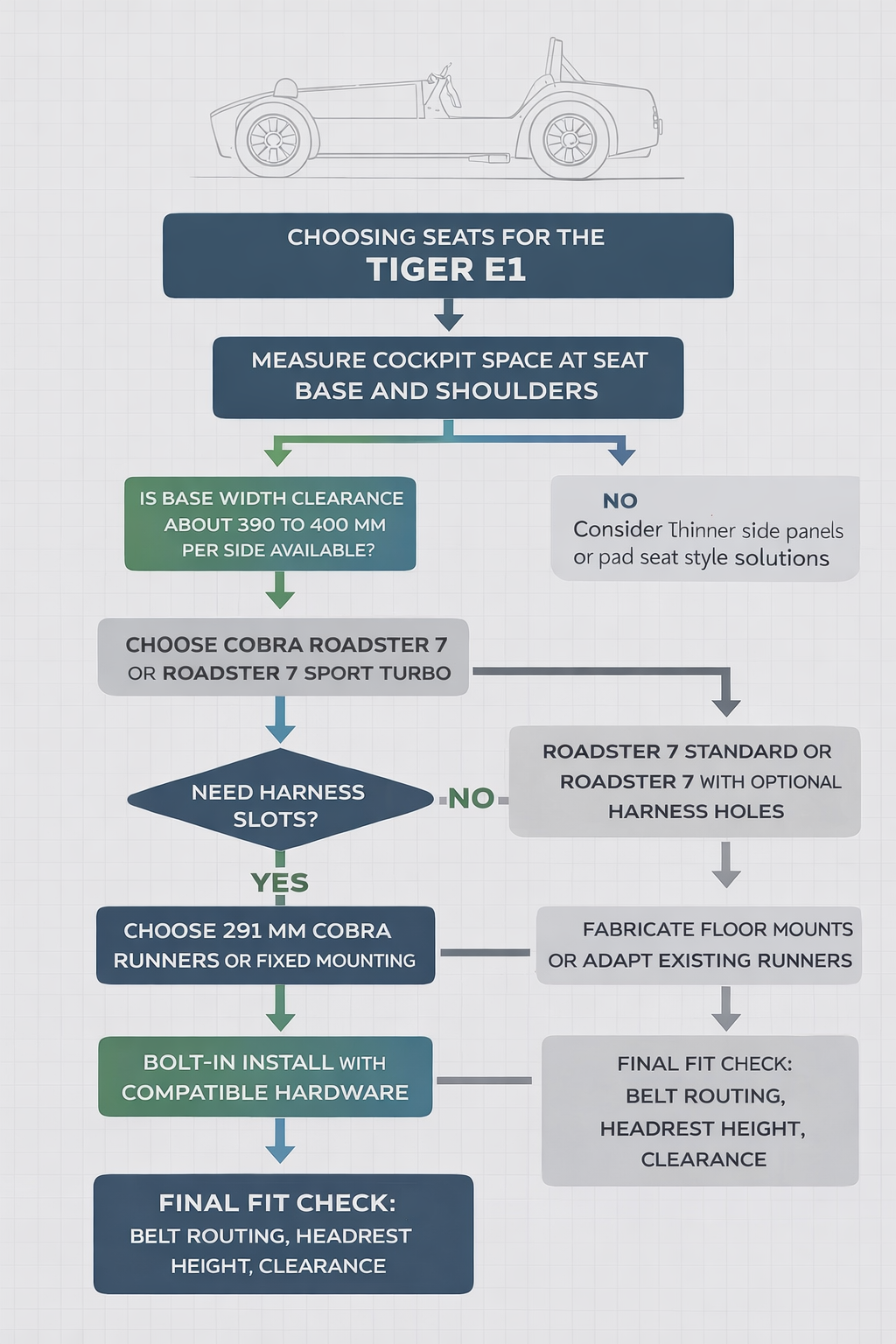


Final Thoughts: Choosing Seats for the Tiger E1
Finding seats that fit the Tiger E1 can be challenging because of the car’s extremely small cockpit. Many modern bucket seats are simply too large to fit comfortably without modifying the chassis or bodywork.
Seats like the Cobra Roadster 7 and Roadster 7 Sport Turbo solve this problem by using very narrow dimensions specifically designed for lightweight roadster style vehicles. Their compact size allows them to fit cleanly inside the Tiger E1 while still providing comfort and support.
By choosing seats that are known to work with these cars, you can avoid unnecessary fabrication and create a clean installation that suits both the design and driving style of the Tiger E1.