“Safety Devices 2″/2″ 4 Point Bolt-In Road Legal Harness” has been added to your basket. View basket
Fitting A Road Legal Harness To The Middle Rear Seat
Customer question, answered
A customer rang wanting a road legal harness for the middle seat of the second row of his Land Rover Defender, for occasional use, and asked us to confirm the mounting points. It is a fair question and the honest first answer is that nobody can name them without seeing the car, because the centre rear seat is the least standardised position in the whole vehicle. What we can do is tell you what to look for, which harness actually suits that seat, and why the one most people ask for is usually the wrong one.
The short version: a four point is the harness everybody pictures, and the middle seat is the one place it rarely fits. A three point is the answer far more often. Here is why.
- Road legal means an E mark to ECE R16 on the webbing or a sewn tag, not an FIA label
- A four point needs two anchorages behind the shoulders, and the centre rear seat has no pillar there
- A three point uses three anchorages in the layout many cars already have, from £63.79
- On a classic Defender that seat is a lap belt, so there is no upper anchorage to reuse and one has to be made
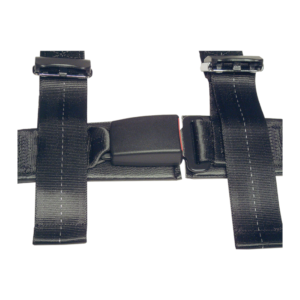
- The seat’s own belt stays fitted and usable, a harness goes alongside it
- On a split fold bench, check whether the belt fixings are on the car or on the folding frame
Start with the car, because this seat is never standard
Every other seat in a car is broadly predictable. The centre rear is not. Depending on the model you might find the upper belt anchorage in the roof lining, in the parcel shelf, or built into the backrest itself, and on some cars there is only a lap belt there at all. Two cars from the same maker, a generation apart, can be completely different.
So before anything else, fold the rear bench forward and look. You want to know three things: where the existing fixings actually are, whether they are bolted to the body of the car or to the folding seat frame, and what thread they take. Send us a photograph of that and we can have a proper conversation. Without it, anyone quoting you mounting points is guessing.
Why the middle seat is the awkward one
A four point harness has two shoulder straps, and they want to run backwards from your shoulders to anchorages at roughly shoulder height. Behind an outer seat there is a pillar to bolt to. Behind the centre seat there is fresh air, the parcel shelf and the back window.
That is not a detail you can work around by mounting lower. The guidance we follow, and the same numbers as our harness fitting guide, puts the shoulder straps at a maximum of 45 degrees below horizontal, and never angled upwards. Drop the anchorage to the boot floor and you are well outside that. It is the single most common mistake in a rear harness install, and it is easy to make because the boot floor is the only convenient thing back there.
There is one more thing to check on the left hand drawing that the drawing cannot show you. A harness is never anchored to the seat or its supports, only to the car. On a split fold rear bench the belt fixings are quite often on the folding frame instead of the floor, and those are no use to you here.
The three point answer
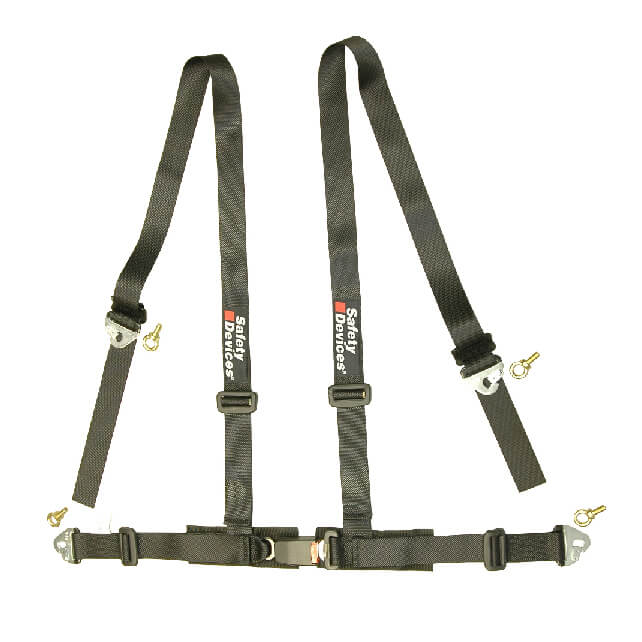
A motorsport three point is one diagonal strap over the shoulder and a lap belt, which is the same architecture as the belt already in the car. It needs three anchorages, in the same places, and the eye bolts supplied with these harnesses are 7/16 inch UNF, which is the usual seat belt anchorage thread. On a good number of cars that means a clip in three point goes onto what is already there without a single new hole.
The catch is in the words good number. It only works if the middle seat has an upper anchorage in the first place, and plenty of cars give that position a lap belt and nothing else. The Defender is one of them, which is the next section.
Check it rather than assume it, but that is the route to look at first, and for occasional use a clip in is the sensible choice because it comes out in seconds when the seat goes back to normal duty.
-
From £99.00 Incl. VATFrom £82.50 Excl. VATPayPal CreditSelect options This product has multiple variants. The options may be chosen on the product page
-
From £120.00 Incl. VATFrom £100.00 Excl. VATPayPal CreditSelect options This product has multiple variants. The options may be chosen on the product page
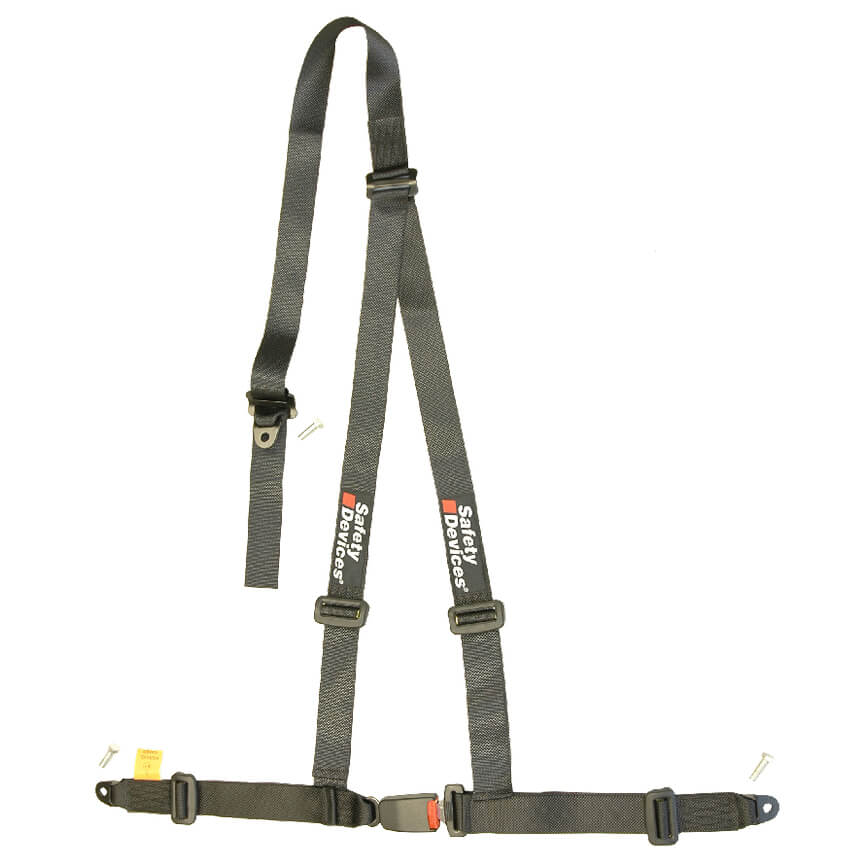
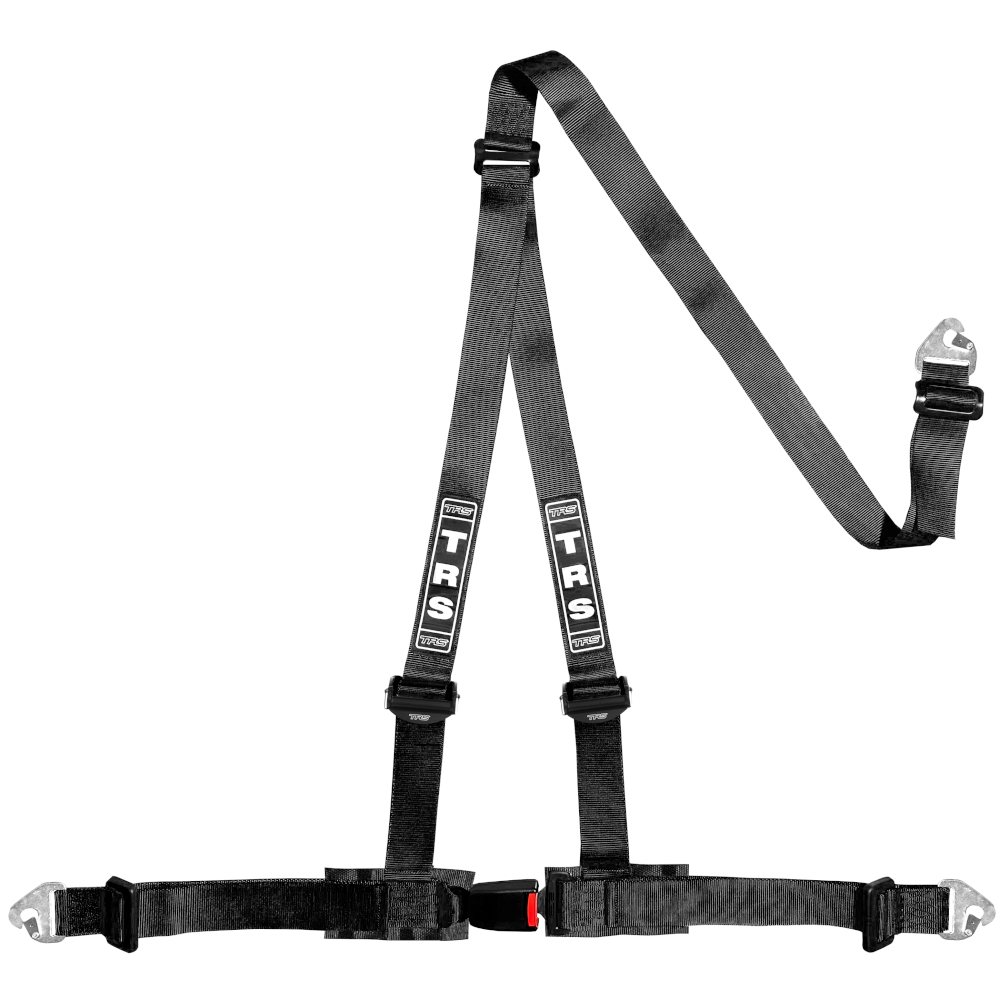
If you want the better made version of the same idea, the TRS Clubman clip in comes in nine colours with aluminium shoulder adjusters, and the strap ends snap onto eye bolts so the whole thing lifts out. For a seat used a few times a year that is worth the difference over a bolt in.
-
From £132.00 Incl. VATFrom £110.00 Excl. VATPayPal CreditAmazing valueSelect options This product has multiple variants. The options may be chosen on the product page
The Land Rover Defender, which is the awkward case
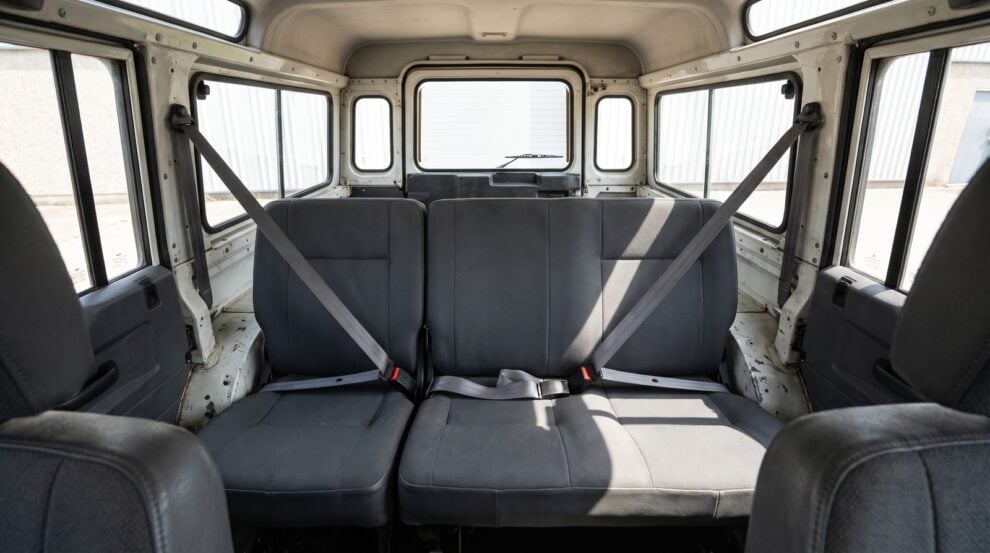
This came up because a customer asked about this exact seat in a Defender, and it turns out to be the perfect worked example. On the classic Defender, the boxy one built up to 2016, the second row is normally two outer three point inertia belts and a plain lap belt in the middle. That is what you are looking at in the photograph at the top of this page. The centre position has a strap across the cushion and the backrest above it is bare.
Which means the comfortable answer in the section above does not apply here. There is no upper anchorage in that position to reuse, because the car was never given one. You have two lap points and empty space above them, and no harness with a diagonal will work until there is something for that diagonal to pull against.
The consolation is that a Defender is a better candidate for that job than most modern cars. The body sides are flat and reachable, the wheel arch boxes are solid and bolted together instead of buried under bonded trim, and you can usually get a hand and a spanner behind whatever you are working on. Defender owners already convert the outer second row positions from lap to three point using a bracket on the wheel arch, so the idea is not exotic. The middle is the harder one, because it sits away from all of that structure.
It is still a fabrication job and a judgement about your particular vehicle, made with the trim off and hands on the metal, so it is not something anyone should be speccing down a phone line. Send us photographs of the second row with the seat base tipped forward and we will tell you honestly what we think you are looking at.
To be clear about which car this section is about: the classic one. The 2020 onwards Defender is a different vehicle in every way that matters here, and it already has a proper three point belt in that centre seat from the factory, so none of the above is your problem. Our Defender work is all for the classic car, and the seats and subframes we cut are all for that shape, so we are not the people to ring about a new one.
For the classic though, we do the lot: a full range of seats and direct fit subframes. If the seat itself is changing as well as the belt, ask about both together and we will quote it in one go.
The one worth paying more for
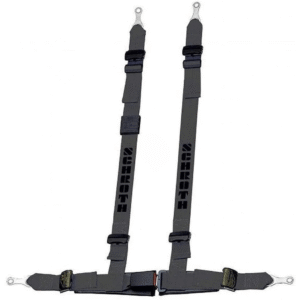
Schroth build a device into the shoulder strap they call ASM, and it exists precisely for this situation: a belt worn in a road car that has no cage and no competition install behind it. If the budget stretches, it is the one we would put in our own car for this job, and it comes in a three point as well as a four.
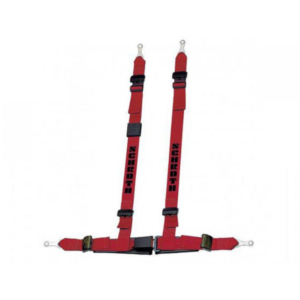
One thing to know before you order. Schroth singles are handed. Every version is listed as driver side or passenger side, and that sets which way round the buckle release faces. There is no centre option, so pick by which hand the person in that seat will reach the release with, and if you are not sure, ring us and we will talk it through.
-
From £169.49 Incl. VATFrom £141.24 Excl. VATPayPal CreditSpeed+ ServiceSelect options This product has multiple variants. The options may be chosen on the product page
-
From £188.33 Incl. VATFrom £156.94 Excl. VATPayPal CreditSelect options This product has multiple variants. The options may be chosen on the product page
-
From £30.00 Incl. VATFrom £25.00 Excl. VATPayPal CreditAmazing valuePerfect add-onSelect options This product has multiple variants. The options may be chosen on the product page
If you have your heart set on a four point
It is not impossible, it just needs somewhere proper for the shoulder straps to go, and that means new anchorages in sound structure at about the right height. In a saloon the rear bulkhead behind the parcel shelf is sometimes workable. In a hatchback or an estate there is usually nothing at the right height at all, and the boot floor is far too low.
The numbers, if you are having it done: steel fixings, minimum 7/16 inch UNF or M12 grade 8.8, or whatever the harness maker specifies. A new point wants a spreader plate behind it, and the metal around it needs to be sound. Whether a given panel on your car is up to it is a judgement someone has to make with the trim off and their hands on it, so this is a job for a fitter who can see it, not for a page on the internet. We will supply the belt and the fixings and tell you honestly if we think the car is not a good candidate.
-
From £105.60 Incl. VATFrom £88.00 Excl. VATPayPal CreditSelect options This product has multiple variants. The options may be chosen on the product page
-
From £112.03 Incl. VATFrom £93.36 Excl. VATPayPal CreditSelect options This product has multiple variants. The options may be chosen on the product page
What road legal actually means here
It means an E mark to ECE R16, printed on the webbing or on a sewn tag, reading something like E4 16 followed by a number. That label is the proof, and as we covered in our piece on street homologation certificates, there is no paper certificate you need to keep in the glovebox here. Every belt carded on this page carries that approval.
An FIA 8853 harness is a different thing. It is competition equipment, it is not E marked, and it is not the answer to this question. If you want the difference set out properly, our four, five or six point guide covers the competition side and the harness without a roll cage guide covers the front seat version of this problem.
Schroth put it well about their own street belts: they are installed to the factory mounting points alongside the factory seat belts. Alongside is the word that matters. The belt that came in that seat stays fitted and stays usable.
| Three point | Four point | |
|---|---|---|
| Anchorages needed | Three, in the layout the seat already uses | Four, including two behind the shoulders |
| Usually fits a centre rear seat | Yes, on a lot of cars | Rarely, without fabrication |
| Typical new holes | Often none | Two, in sound structure at shoulder height |
| Suits occasional use | Yes, especially a clip in | Less so, once it is installed it stays |
| From, inc VAT | £63.79 | £95.88 |
Prices checked 8 September 2026 and are for a single belt. Everything on this page is E marked to ECE R16.
Common questions
Can I just take the existing belt out and put a harness in its place?
No, and you do not need to. A road legal harness goes in alongside the belt that came with the seat, which stays fitted and usable. That is how the makers intend them to be installed and it is how we supply them.
How do I find my mounting points?
Fold the rear bench forward and look at what the existing belt for that seat is bolted to. You want to know whether the fixings are in the body of the car or on the folding seat frame, and what thread they take. Send us a photograph and we will tell you what we think.
Will a four point definitely not fit?
Not definitely, but usually not without making two new anchorages at about shoulder height, and in a hatchback or estate there is often nowhere sensible to put them. Saloons with a solid rear bulkhead are the better case. Tell us the car and we will give you a straight answer.
I have a classic Defender. What do I actually need?
That position has a lap belt, so there is no upper anchorage to reuse and something has to be made before any diagonal strap will work. What that something is depends on your vehicle, so send us photographs of the second row with the seat base tipped forward. We do the classic Defender properly, seats and subframes included, so ask about the whole job at once.
Which side do I order a Schroth in?
Schroth singles are handed, listed as driver side or passenger side, and it sets which way the buckle release faces. For a centre seat, choose by which hand the occupant will reach the release with.
Do I need eye bolts as well?
A clip in harness needs eye bolts in the anchorages to snap onto. Some come with them, some do not, and we sell them separately. Tell us which belt you are ordering and we will make sure the fixings go in the box.
Is this something you can fit for us?
Ring us and ask. Whether it is a straightforward swap onto existing points or a fabrication job depends entirely on what is behind that seat in your car, which is why we keep asking for the photograph.
💬
The next stepSend us the car and a photo of the folded bench
Those two between them settle whether this is a clip in three point off the existing points or a bigger job, and it takes us a couple of minutes to tell you which. Ring Garreth and Cameron on 0115 9893488.
Need a personal recommendation?
We're here to ensure you pick the right seat.
Contact us today.