Call Garreth, Cameron & Jack: 0115 647 8650

FREE UK shipping on orders over £100.00 & FREE gifts on checkout

Your garage NewAdd your car and see the parts that fit
Useful Links
Your Account

Talk to us

Garreth, Cameron & Jack · Mon to Fri
Call 0115 647 8650Free advice on your build
Thanks, that’s with us. We reply the same working day.
That didn’t send. Please give us a call instead.

Useful Links

Quick Access

Want to chat?

Call Garreth, Cameron, Jack
Today On: 0115 647 8650
Click Here For Our Contact Form


CDS VS T45 Roll Cages: What's The Difference And Why Upgrade?

Roll cage guide

When you choose a roll cage, the steel it is made from is one of the biggest decisions, and one of the most misunderstood. Most cages are described as either CDS or T45, as if those were two rival materials. They are not quite that.

CDS, cold drawn tube with no seam, is the way the tube is made. T45 is a particular steel specification, and T45 tube is itself cold drawn seam-free. The real comparison is between a standard carbon steel CDS tube and T45. Here is what separates them, what the rules actually ask for, and when the upgrade is worth paying for.

  • CDS means cold drawn tube with no seam: a way of making tube, not a material
  • T45 (BS4 T45) is a carbon manganese steel, and it is also cold drawn seam-free
  • Custom Cages quote T45 at 620 N/mm2 minimum yield against 370 N/mm2 for their CDS
  • Neither the FIA nor Motorsport UK rules name T45; they set a material and minimum tube sizes
  • Standard CDS is the lower cost choice for most club and track day builds
  • Whichever steel you choose, the installation matters as much as the tube
A bare steel Custom Cages Historic T45 roll cage welded into a stripped BMW 2002 shell
A Custom Cages Historic T45 cage fitted in a stripped BMW 2002 shell.

What CDS tubing is

CDS stands for cold drawn tube made with no seam (the D is for drawn, the S for its seam-free construction). The tube starts as a hollow with no seam and is drawn through a die at room temperature, which sizes it accurately and gives it a consistent wall thickness all the way round.

The important part is that there is no seam. Cheaper tube is often ERW, electric resistance welded, which is rolled from flat strip and welded along its length. That seam is a weak line, and both the FIA and Motorsport UK specify cold drawn seam-free tube for roll cages, so ERW is not an option for a competition cage.

When a cage is simply described as CDS, it usually means cold drawn seam-free tube in a standard unalloyed carbon steel. That is the baseline most cages are built from.

T45: a type of CDS tube

T45 is a British tube specification, BS4 T45. It is made from a carbon manganese steel, not a chrome moly steel as is sometimes thought, and it is produced as cold drawn seam-free tube. So a T45 cage is a CDS cage too, just in a stronger steel.

That extra strength is the whole point. Built to the same dimensions, a T45 cage is the stronger structure. On a cage whose whole design has been homologated or certified, the extra strength can also allow thinner walled tube, which is where the weight saving comes from.

The key differences

The figures below are Custom Cages’ own published minimums for the two tubes they use: their E355 grade CDS and their T45. Other makers’ figures will be in the same area, but check the specification for the cage you are buying.

Standard CDS (E355)T45
How it is madeCold drawn, no seamCold drawn, no seam
MaterialUnalloyed carbon steelCarbon manganese steel (BS4 T45)
Minimum yield strength370 N/mm2620 N/mm2
Minimum tensile strength510 N/mm2700 N/mm2
ElongationAbout 25 percentAbout 15 percent
Named in FIA or Motorsport UK rulesMeets the material specificationNot named; meets the specification
CostLowerHigher

Two points in the table are worth pausing on. First, the higher elongation of standard CDS means it stretches further before it breaks, so it is the more ductile of the two. Second, neither steel is described by its maker as more corrosion resistant: both are carbon steels and both need painting or powder coating to protect them.

What the regulations actually ask for

It is often said that high level motorsport requires T45. The rulebooks do not say that. Neither FIA Appendix J Article 253 nor the Motorsport UK regulations name T45. What they specify is cold drawn seam-free unalloyed carbon steel with a maximum of 0.3 percent carbon, and minimum tube sizes: 45 x 2.5mm or 50 x 2.0mm for the main hoop, and 38 x 2.5mm or 40 x 2.0mm for the other members.

A cage built to the published specification must meet those sizes whatever the steel. A lighter, thinner walled T45 cage is only legal where that specific design is homologated or certified.
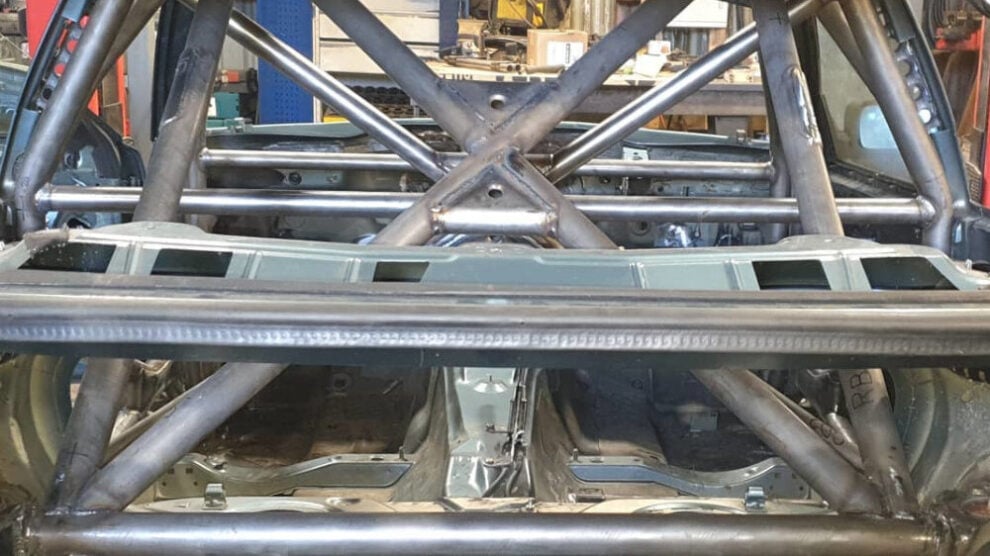
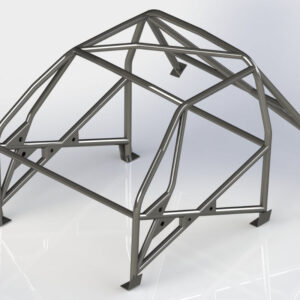
A bare steel weld-in multipoint roll cage with X bracing in a stripped BMW E36 Coupe shell, seen from the rear
A bare steel JP Cages weld-in multipoint cage in a stripped BMW E36 Coupe shell.

Your championship can also set its own rules, and some cars, including recent FIA homologated cars, need a homologated or certified cage outright. Always read the regulations for your class before you order, and ask us if you want help checking them. Our guide to T45 or CDS roll cage steel goes through the regulations and the costs in more detail.

Why choose T45

Strength. Roughly two thirds more yield strength than standard CDS means a stronger cage from the same size of tube.

Weight. On a homologated or certified design, the extra strength allows thinner walled tube and a lighter cage. For a car where every kilo is being counted, that matters.

Fabrication. Custom Cages describe T45 as bending and welding well, and it is their biggest selling tube. Welding it properly still needs the right filler wire and a competent fabricator.

Availability. Some cage designs, particularly lightweight competition and homologated cages, are only offered in T45.

Why standard CDS might be right for you

For club rallying, sprints, autotests and track days, a CDS cage built to the published specification is a proven, legal choice, and it costs noticeably less. The money you save can go into the seats, harnesses and padding that make the cage do its job.

Garreth’s advice is to think about where the car is going. If you expect to move up a level in a season or two, buy the cage you will need then, because taking out and refitting a finished cage costs more than the difference in steel.

Who makes CDS and T45 cages

Safety Devices. A long established UK maker. Most of their range is bolt-in cages designed for specific cars, and they also make full CDS weld-in cages and T45 weld-in cages for cars such as the Ford Escort, Honda Civic EK and BMW M4. See the Safety Devices cages.

Custom Cages. UK made kits in both steels, with the steel named in every product title. T45 makes up the larger share of their range, alongside CDS National Spec and Historic kits. See the Custom Cages range.

JP Cages. Half cages, bolt-in competition cages and weld-in kits, in CDS and T45 depending on the design, including BS4 T45 homologated bolt-in cages. See the JP cages.

Installation matters

The best tube in the world will not protect you if the cage is badly fitted. A weld-in cage depends on sound welds all the way round every joint and on proper spreader or foot plates, and a bolt-in cage depends on the right plates and bolts at every mounting point. Plan a professional fit into the budget unless you are an experienced fabricator yourself. Our guide to roll cage installation for track cars covers what to expect.

Yes. CDS is how the tube is made, and T45 tube is cold drawn seam-free in a stronger carbon manganese steel.

Custom Cages quote a minimum yield of 620 N/mm2 for T45 against 370 N/mm2 for their standard CDS.

No. Neither rulebook names T45; they set a material specification and minimum tube sizes, and your championship may add its own rules.

Only where the design is homologated or certified to use thinner tube; built to the same sizes, it weighs the same.

No. Both are carbon steels and both need paint or powder coat.

💬
Our viewCDS for most, T45 for weight

Standard CDS suits most club builds; T45 earns its cost on lightweight homologated cages.

Need a personal recommendation?

We're here to ensure you pick the right seat. Contact us today.
Our showroom virtual walk through!
Have a walk around our showroom before you even buy your new seats. 
Our hands on experience, is what allows us to bring you our recommendations.
Free UK Shipping

On all orders above £100

Showroom

Try before you buy, by appointment

Delivery Tracking

Updates by email and text