

Roll Cage Rules Explained: What Motorsport UK And The FIA Actually Require
Cage questions arrive in a particular order. Will this one pass, can I bolt it in, does it need padding, and is T45 worth the money. Underneath all four is the same worry: spending four figures on a structure that gets turned away at sign-on.
So we went and read the regulations properly, in the current documents rather than in other people’s blog posts, and wrote down what they say. Everything below is from the Motorsport UK National Competition Rules 2026 and the FIA’s Appendix J Article 253. Where the two differ, and they do in a couple of places worth knowing, we say so. Where we could not verify something, we say that too.
Where the rules actually live
For UK national events, roll cages sit in the Motorsport UK National Competition Rules, Chapter 7, Appendix 3, Roll Over Protection Systems, with the drawings in Chapter 7 Appendix 13. That is worth writing down, because plenty of forum answers send people to the racing chapter, which covers circuit sporting regulations and says nothing about cages. In the older lettered Yearbook the cage rules lived in the safety section, Section K.
Appendix 3 states its own scope plainly: it is for national and lower status events, it tells you to check the FIA requirements for groups and classes it does not cover, and it says the ASN requirements are the minimum acceptable. Motorsport UK also say they align with the FIA wherever possible, which is why most of the numbers below are the same in both documents.
On the FIA side, Article 253-8 of Appendix J is the safety cage article, and it carries a trap covered in the next section.
Three ways to a legal cage
The FIA sets out the routes most explicitly, and its 2020 text lists them as: fabricated in compliance with the articles that follow, or homologated or certified by an ASN, or homologated by the FIA. In practice that is the framework people mean when they talk about cage approval.
The Motorsport UK version reads slightly differently. Appendix 3 does not publish a tidy list of three named routes. It gives a specification and drawings to build to, then an Exceptions article under which a manufacturer can apply for a ROPS Certificate, and it refers to FIA homologated cages throughout as an already recognised category. Its own vocabulary is Homologated, ASN Certified and ROPS Certificate. You will see the phrase “Motorsport UK approved” in the trade, including on listings, and it is useful shorthand, but it is not a term the regulation defines.
One version trap worth knowing on the FIA side. The 2026 Article 253-8 applies only to cars homologated from 1 January 2021, and for those cars it offers only the homologated or certified routes, with no build-to-specification option and no tube table. For cars homologated between 2017 and 2020 you want the 2020 edition of Appendix J, and for pre-2017 cars the 2016 edition. Anyone quoting a tube table at you should be able to say which year they are quoting.
The tube sizes
These are the minimums, from the FIA’s 2020 Appendix J table and matched by the Motorsport UK figures. Only circular section tube is allowed.
| Member | Minimum dimensions |
|---|---|
| Main rollbar, or lateral rollbars plus rear transverse member | 45 x 2.5 mm, or 50 x 2.0 mm |
| Lateral half-rollbars and other parts of the cage | 38 x 2.5 mm, or 40 x 2.0 mm |
| Harness bars (Motorsport UK) | 38 x 2.5 mm, or 40 x 2.0 mm |
Material, in both documents, is cold drawn seamless unalloyed carbon steel with a maximum 0.3 per cent carbon. On strength the two bodies word it differently and it is worth being precise: the FIA table specifies a minimum tensile strength of 350 N/mm2, while Motorsport UK specifies a minimum yield strength of 350 N/mm2. Same number, different property, so quote whichever document applies to you and do not treat them as one rule.
Motorsport UK also set separate figures for other vehicle types, including single seaters split at 470 kg, and they prohibit aluminium alloy cages outright.
Bolt-in is allowed, to a spec
The idea that bolt-in cages are somehow not proper is trade folklore. Both documents permit bolted mounting feet and both set the same numbers for them.
Each leg of a main, lateral or front rollbar takes at least three bolts, minimum M8 and ISO grade 8.8, onto a steel reinforcement plate welded to the bodyshell, at least 3 mm thick and at least 120 cm2 in area. Backstays take at least two M8 bolts with feet of at least 60 cm2, or a single bolt in double shear where a bush is welded into the backstay. Welding the foot or leg directly to the shell is the alternative, not the requirement.
What you cannot do is put a bolted joint inside the main, front or lateral rollbar itself. Motorsport UK are explicit that demountable joints must not be used there because they act as hinges in the principal structure; they are for attaching members to the rollbars.
We could not find any general regulation banning bolt-in cages in a named class. Certain FIA variants and Sport UTVs must have a homologated cage, which a homologated bolt-in satisfies. If somebody tells you your series requires weld-in, that will be in your championship’s own regulations, so read those.
- 3 bolts per rollbar leg, minimum M8 grade 8.8
- Reinforcement plate minimum 3 mm thick, 120 cm2
- Backstays 2 x M8 with 60 cm2 feet
- No bolted joints within the main hoops themselves
Padding, and who requires it
This one differs between the two rulebooks and it is the difference most often got wrong.
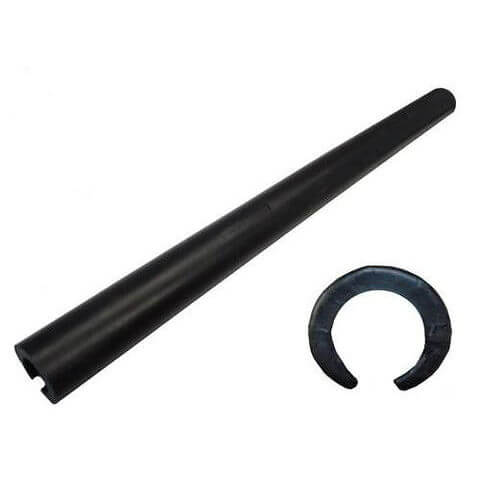
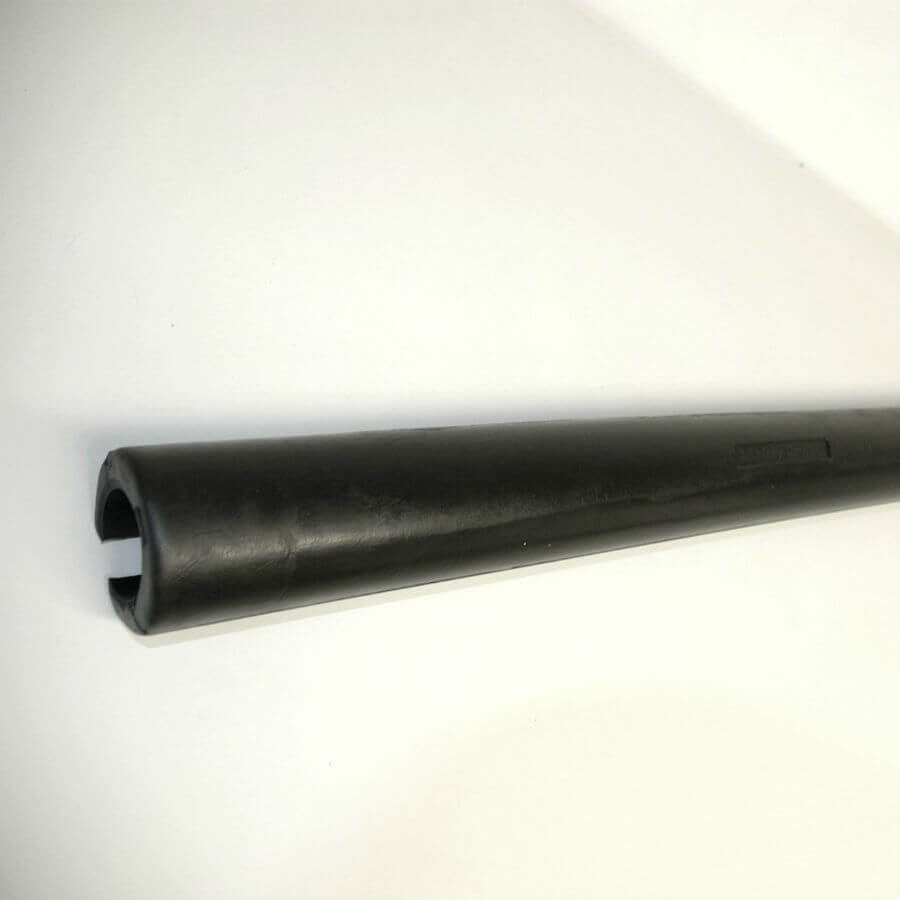
Under FIA Appendix J, padding is compulsory. The tubes identified on the FIA’s own drawing and all roof reinforcements must carry padding compliant with FIA 8857-2001 Type A, listed on FIA Technical List No. 23, fixed so it cannot move on the tube. It applies to all categories, and where there is no co-driver it is compulsory on the driver’s side only.
Under the Motorsport UK NCR it is worded as advice. Appendix 3 says non-flammable padding should be provided where bodies or helmets could contact the cage, and that it is recommended that tubes within 150 mm of an occupant’s helmet are covered with a suitable energy absorbing material, pointing at FIA homologated materials. The designation 8857 does not appear in the NCR at all.
So the honest retail answer: if you are running to FIA regulations, 8857-2001 Type A is required. At a Motorsport UK national event the NCR asks for it in softer language, and your championship may well make it compulsory anyway. It is inexpensive, so most people fit it regardless of which column they fall into.


CDS, T45 and an honest word
We sell cages in both materials, so here is the position as the regulations actually state it.
Both the FIA and Motorsport UK specify cold drawn seamless unalloyed carbon steel and a minimum strength figure. The designation T45 does not appear in either document. We searched the full text of the Motorsport UK NCR 2026 and the FIA Appendix J Article 253 in its 2026, 2020 and 2016 editions, and it is not there. T45 is a British tube specification, not a regulatory category.
What T45 genuinely is: a cold drawn seamless carbon-manganese tube with roughly double the yield strength of standard CDS, per the manufacturers’ own published figures. It comfortably exceeds the minimum. What it does not do, on the build-to-specification route, is buy you any dimensional allowance, because the minimum tube sizes above apply whatever the material is made from. A lighter cage in thinner-walled T45 becomes legal where that specific design is homologated or certified, since approval covers the design as a whole.
Garreth’s take across the counter: T45 is a real advantage where weight matters and where the cage is a certified design built around it, and it is a genuine premium product. It is not a magic word that makes a cage more legal, and anybody selling it to you as one is overselling.
What catches people out
All of these are written into the regulations, and all of them have cost somebody a weekend.
You cannot modify a homologated or certified cage. The FIA is blunt: any modification is forbidden, and machining or welding that permanently changes the material or the cage counts. Motorsport UK name the only permitted additions to a homologated cage: roof reinforcement, windscreen pillar reinforcement, doorbars and harness bars. Drilling a cage to hang something off it is a modification.
Repairs go back to the maker. After an accident, repairs to a homologated or certified cage must be done by the cage manufacturer or with their approval.
The paperwork travels with the car. An authentic copy of the homologation document or certificate has to be available for scrutineers, and the cage carries an identification plate that cannot be moved or temporarily fixed on. Motorsport UK require that plate on any cage made after 1 January 1997 for which a certificate was issued.
A cage is built for one shell. The regulation asks for a close fit to the bodyshell and a design suited to the particular vehicle. A cage out of a different car is not a starting point.
Hoops are one piece. Main, front and lateral rollbars must be made in one piece without joints, smooth and even, no ripples or cracks.
Nothing runs through or alongside the cage. Tubes must not carry fluids or any other item, and inside the cockpit you cannot route battery cables, fluid lines or extinguisher lines between the shell’s side members and the cage. Windscreen washer fluid is the exception Motorsport UK allow.
Chrome plating is banned, and a cage must not be used to achieve aerodynamic effect.
-
From £2,237.42 Incl. VATFrom £1,864.52 Excl. VATPayPal CreditMade to orderKlarna ReadyNew for 2026Select options This product has multiple variants. The options may be chosen on the product page
-
From £711.36 Incl. VATFrom £592.80 Excl. VATPayPal CreditMade to orderKlarna ReadyNew for 2026Select options This product has multiple variants. The options may be chosen on the product page


What we sell, and how to choose
Our range covers Custom Cages and Safety Devices, weld-in and bolt-in, CDS and T45, built for specific shells. The listings carry the approval status, the fitment and the material, and the approval line is the one to read against your regulations before anything else.
The right order is regulations first, then shell, then material, then budget. Get the first two right and the rest is a comfortable decision. Get them wrong and the price is irrelevant.
- Built for the specific shell, not universal
- Weld-in and bolt-in options across the range
- CDS and T45 where the maker offers both
- Approval status stated on every listing
Common questions
Is a bolt-in cage legal?
Do I have to fit cage padding?
Is T45 required by the FIA?
Can I drill my cage to mount something?
Can I move a cage into another car?
What paperwork do I need at scrutineering?
The short version
The rules are in the Motorsport UK NCR Chapter 7 Appendix 3, and in FIA Appendix J Article 253-8 if you are running to FIA regulations. A cage is legal by being built to the published specification, or by carrying an ASN certificate, or by being FIA homologated. Minimum tube is 45 x 2.5 or 50 x 2.0 for the main hoop and 38 x 2.5 or 40 x 2.0 for most of the rest.
Bolt-in is allowed if the feet meet spec. Padding is compulsory under FIA rules and strongly advised under the Motorsport UK wording. And a homologated cage must not be modified, which is the rule that catches the most people.
Tell us the car, the championship and whether you want weld-in or bolt-in, and we will point you at the cages that suit all three. Cameron will check the fitment against your shell before anything is ordered, because a cage is the one product where the wrong choice is measured in weekends as well as money.
The range is under Custom Cages and across the Safety Devices listings by vehicle. Ring 0115 9893488 and we will work through it with you.