Call Garreth, Cameron & Jack: 0115 647 8650

FREE UK shipping on orders over £100.00 & FREE gifts on checkout

Your garage NewAdd your car and see the parts that fit
Useful Links
Your Account

Talk to us

Garreth, Cameron & Jack · Mon to Fri
Call 0115 647 8650Free advice on your build
Thanks, that’s with us. We reply the same working day.
That didn’t send. Please give us a call instead.

Useful Links

Quick Access

Want to chat?

Call Garreth, Cameron, Jack
Today On: 0115 647 8650
Click Here For Our Contact Form


You've unlocked three free gifts All three are in your basket at no charge.
  • Gift box
  • 4WD Mini RC Drift Car - BMW
  • GSM Performance Customer Car Colouring Book Edition 1

Is FIA 8855-1999 Being Phased Out? What Your Seat Date Really Means

FIA seat standards, dated and sourced

A rumour keeps landing in our inbox, and it recently arrived dressed as a discount request: the FIA 8855-1999 seat standard is no longer valid from the end of 2026, so surely the seats should be cheaper. It is a tidy story, and it is wrong. The FIA has said in writing that the standard is not being withdrawn, and its own current seat list shows 8855-1999 seats still being manufactured into 2029 and valid on their labels into 2034.

So where did the end of 2026 come from, what do the dates on a seat label actually mean, and when does any of it matter to what you drive? This page answers all three, with every date taken from the FIA documents themselves.

  • The FIA has stated the 8855-1999 standard will not be withdrawn: there is no end-of-2026 switch-off
  • The current FIA list shows 8855-1999 seats manufactured to between 2027 and 2029, valid on their labels to between 2032 and 2034
  • The date that matters is on the seat label: not valid after equals year of manufacture plus five
  • The newer standards run ten years per seat: 8855-2021 and the advanced FIA 8862
  • Outside competition scrutineering nobody checks the date: road, track day and sim use carry on regardless
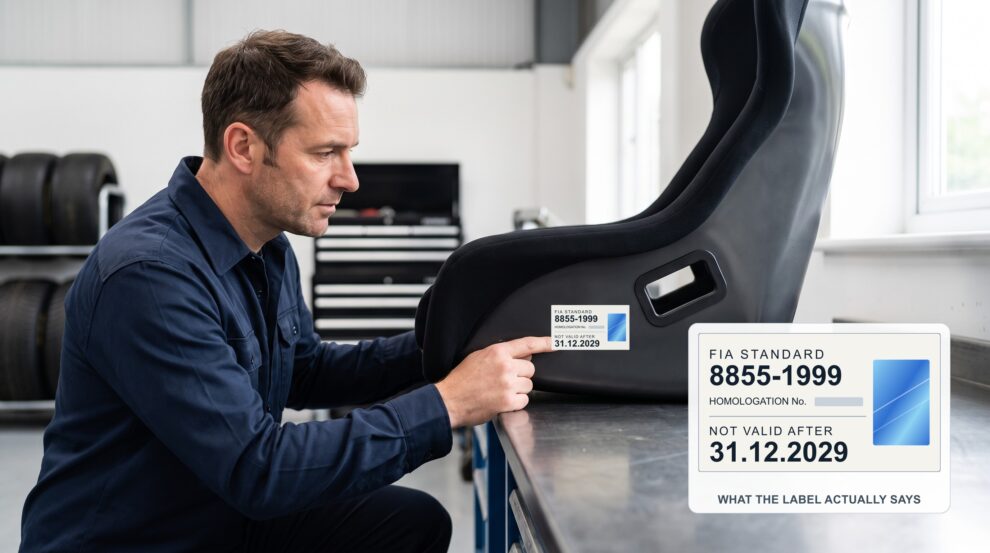
A technician pointing at the FIA homologation label low on the side of a black bucket seat shell, clear of the harness slot, with the label enlarged alongside showing FIA Standard 8855-1999, a blue hologram and a not valid after date of 31.12.2029
The label sits low on the SIDE of the shell, clear of the harness slot, and the whole argument lives on something this size. Learn to read it and the scary forum threads sort themselves out.

The straight answer first

The 8855-1999 standard is not being cancelled, banned or switched off at the end of 2026. When the FIA announced the replacement 8855-2021 standard it said plainly that 8855-1999 will not be withdrawn, and its Technical List No 12, the live register of every 8855-1999 seat, tells the same story in numbers: over 140 current homologations allow manufacture into 2027, 2028 or 2029, and the seats built under them carry validity dates reaching 2032 to 2034. A Sparco Sprint L bought new today can be built as late as November 2029 and wear a label valid until 2034.

What did change is quieter. Since the last day of 2022 the FIA accepts no brand new 8855-1999 seat designs, only renewals of existing ones, so the standard is slowly tapering off over the next decade while its replacement grows. A taper is not an expiry, and nothing about it lands in 2026.

Where the end of 2026 idea comes from

Two real facts got mangled together. First, the label maths: an 8855-1999 seat is valid for five years from its year of manufacture, so every seat built in 2021 carries not valid after 2026 on its label. Plenty of seats bought around the standard-change headlines say exactly that, and a photo of one label plus a forum thread does the rest. Second, the deadline that does exist, 31 December 2022 for approving brand new 8855-1999 designs, read like an ending to anyone skimming.

There is also a genuine FIA end date floating around that belongs to a different standard entirely: from 31 December 2028 the old 8855-1991 standard, the one from the nineties, stops being accepted. Swap a 91 for a 99 in a forum post and the myth writes itself.

The dates the FIA has actually published

20202022202420262028203020322034Dec 2020 to Jan 2021:8855-2021 standardpublished and in force31 Dec 2022: last brand new8855-1999 homologations,re-homologation only after31 Dec 2028: 8855-1991,the NINETIES standard,leaves the FIA listslast manufacture dates on thecurrent 8855-1999 homologationslatest not-valid-after dateson 8855-1999 seat labelsend of 2026:nothing on the FIAcalendar happens here

Every date the FIA has actually published for the seat standards, on one line. The 8855-1999 story is a slow taper through the thirties, not a cliff, and the end of 2026 sits in empty space.

DateWhat actually happensWhich standard
December 2020The new seat standard is published8855-2021
1 January 2021First seats approved to the new standard8855-2021
31 December 2022Last date for approving brand new designs; existing designs renew instead8855-1999
31 December 2028The nineties standard stops being accepted8855-1991
2027 to 2029Final manufacture dates on the current homologations8855-1999
2032 to 2034Latest not-valid-after dates a new seat label can carry8855-1999
End of 2026NothingNo standard

Sources: the FIA announcement of 8855-2021, the FIA clarification note of June 2022, and FIA Technical List No 12 in its current edition, checked 24 August 2026.

How to read the label on your seat

Every homologated seat carries a small label with the standard, the homologation number and a not valid after year, and the FIA is explicit that the label is the authority: the validity of a seat is always what its own label shows. For 8855-1999 that year is the year of manufacture plus five. So two identical seats on the same shelf can carry different dates, and a seat bought new late in a homologation carries the latest date of all.

When the label year passes, the seat does not dissolve. For competition use a manufacturer can revalidate a returned seat and extend it by up to two further years with an extra label, and outside competition the date was never being checked in the first place. What we tell customers on the phone is simple: buy on the freshest date you can get, which is what buying new from stock gives you, and let the label do its counting from there.

Seat built inLabel says not valid after
20212026, and this row is where the whole rumour started
20242029
20252030
20262031
2029, the last build year on the longest current homologations2034

The five year rule worked through. Year of manufacture plus five, straight off the label, before any manufacturer revalidation is counted.

We are a retailer, not your scrutineerChampionship regulations decide what any race or rally car must run, they change, and the rulebook and the scrutineer always have the final word. Tell us the series you are entering and we will match the seat to its regulations before you order.

When the date matters, and when it does not

The date on the label exists for one audience: competition scrutineering. If your car is inspected against a rulebook that requires an in-date homologated seat, the label needs to be in date on the day, and that is the entire population of people who should care. Road cars are not scrutineered. Sim rigs are certainly not scrutineered. Track days sit with whoever runs them, so check the organiser’s requirements, and most ask for solid installation over paperwork.

Which is why the in-date club seats below are the honest buy for almost everyone reading this page: current production, fresh labels, and a decade of paperwork ahead of them if a competition entry ever appears. Examples from the range, all in stock:

The ten year route, if the date bothers you

If you want the longest possible paper life, two newer standards carry ten year validity per seat instead of five. The 8855-2021 standard is the direct successor, built to roughly double the strength of the old test and written so a seat can be homologated with or without a head restraint. Above it sits the advanced FIA 8862 standard, the one top-flight rulebooks name, where the seat is tested and homologated together with its mounts.

The 8862 seats are the ten year seats we hold in stock, and they are serious kit at serious money. Garreth’s steer is blunt: nobody should buy a four figure seat to cure date anxiety, you buy one because your championship demands it or because you want the best shell made, and for everyone else the Sprint L at £284.40 with a fresh five year label is the better spend. Examples from the ten year shelf:

Common questions

No. The FIA accepts no brand new 8855-1999 designs since the end of 2022, but existing homologations renew and run: the current FIA list allows manufacture into 2027, 2028 and 2029 depending on the seat, and those seats stay valid for five years from manufacture. The standard fades out through the early thirties.

Only a scrutineer reads that date, so it matters if you compete under rules requiring an in-date seat, and even then a manufacturer revalidation can extend a returned seat by up to two years. For road, track day and sim use the seat carries on exactly as it did the day before the label rolled over.

Yes, easily. Buying new from current stock means a recent manufacture date, so the label runs five years from there. Seats built at the end of their homologations will carry dates as late as 2032 to 2034.

That belongs to 8855-1991, the standard from the nineties, which stops being accepted after 31 December 2028. It has nothing to do with 8855-1999, however often the two get swapped in forum threads.

Not even slightly. No one scrutineers a sim rig, and an out-of-date FIA seat loses none of its stiffness or comfort. It is one reason ex-competition shells end up in rigs, and our sim rig guides cover that whole world.

Only if a rulebook you compete under demands one, or you simply want the strongest shell made. The ten year validity is real, but so is the price gap, and a club racer replacing a seat every decade anyway gains little from the longer paper life. Ring us with the series and we will give you the honest answer for it.

💬
The next stepTell us the series, or just tell us the car

If a rulebook is involved, name it and Cameron will match a seat to its regulations with the freshest label in the building. If no rulebook is involved, the date was never your problem, and the right seat is the one that fits you and the car. Either way it is a five minute call on 0115 647 8650.

Need a personal recommendation?

We're here to ensure you pick the right seat. Contact us today.
Our showroom virtual walk through!
Have a walk around our showroom before you even buy your new seats. 
Our hands on experience, is what allows us to bring you our recommendations.
Free UK Shipping

On all orders above £100

Showroom

Try before you buy, by appointment

Delivery Tracking

Updates by email and text