Call Garreth, Cameron & Jack: 0115 647 8650

FREE UK shipping on orders over £100.00 & FREE gifts on checkout

Your garage NewAdd your car and see the parts that fit
Useful Links
Your Account

Talk to us

Garreth, Cameron & Jack · Mon to Fri
Call 0115 647 8650Free advice on your build
Thanks, that’s with us. We reply the same working day.
That didn’t send. Please give us a call instead.

Useful Links

Quick Access

Want to chat?

Call Garreth, Cameron, Jack
Today On: 0115 647 8650
Click Here For Our Contact Form


Do Schroth Road-Legal Harnesses Come with a Street Homologation Certificate?

Harness question

We get asked this a lot: when you buy a Schroth harness for a road car, does a street homologation certificate come in the box? The short answer is no. There is no separate paper certificate. The proof of approval is on the harness itself, on the labels sewn into the webbing, and the box carries Schroth's fitting instructions.

This guide explains what homologation means for a harness, what the ECE R16 and FIA approvals are, how to read the labels, and which Schroth models carry which approval. It is general product information, not legal advice: whether a harness is acceptable in your car on the road is a question for your testing station and your insurer, and in competition it is for your scrutineer.

  • Schroth road harnesses do not come with a separate paper certificate
  • The approval is shown on labels sewn into the harness webbing
  • ECE R16 is the UN regulation that covers seat belts for road vehicles
  • FIA approval is for motorsport and FIA labels carry a "not valid after" year
  • The Profi II-FE ASM and Lotus II-FE ASM carry both FIA and ECE approval
  • Your testing station, insurer or scrutineer has the final say on your car
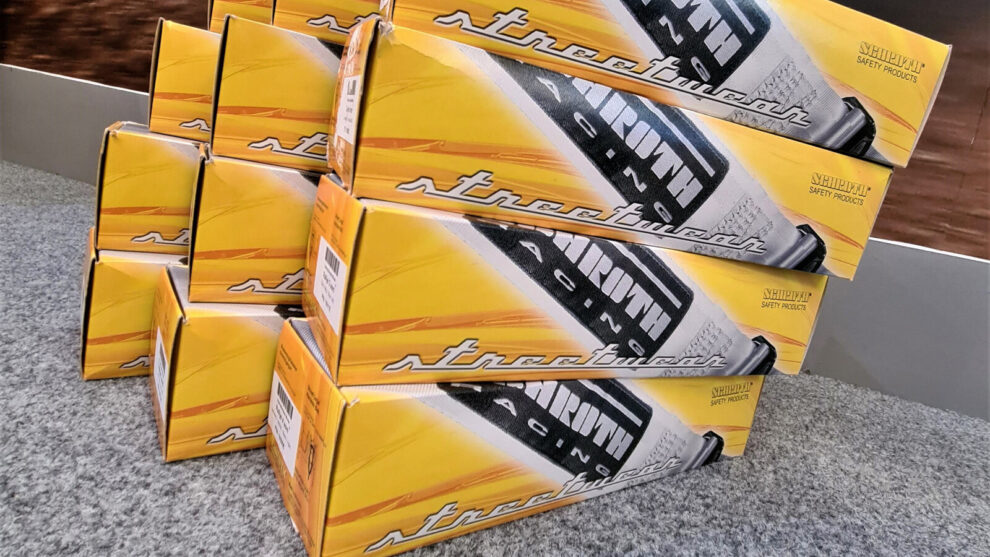
Boxed Schroth Racing street harnesses stacked on the carpet of the GSM Performance showroom
A delivery of boxed Schroth street harnesses on our showroom floor.

What homologation means for a harness

Homologation is the formal approval that a product has been tested against a published standard. For a harness it means a sample of that design has been tested by, or on behalf of, an approval body, and each harness made to that design is then marked to show it.

There are two families of approval you will see on harnesses sold in the UK:

  • ECE R16. A UN regulation that covers safety belts and restraint systems for road vehicles. A harness approved to it carries an E mark.
  • FIA. The motorsport standards set by the FIA, currently 8853-2016 for most competition harnesses, with older 8853/98 and 8854/98 approved harnesses still found in the market.

Some harnesses carry both approvals, most carry one. The approval belongs to the harness design and to that particular harness, and it is the label on the harness that tells you which it has.

ECE R16 and the E mark

A harness approved to ECE R16 has an approval label with a capital E inside a circle, followed by a number, and an approval code. The number is the country whose authority granted the approval. E4, for example, is the Netherlands and E11 is the United Kingdom. An approval granted by any of the countries that apply the regulation is marked the same way, so an E1 or E4 label on a German made harness is normal.

The testing behind ECE R16 covers the webbing, the buckle, the adjusters and the harness as a complete system under load. That is why a road approved harness is sold as a complete unit and should not be mixed with parts from another harness.

What the E mark does not do is decide whether a harness is acceptable in a particular car. That depends on the car, the seat, the anchorages and how it is fitted. If you are fitting a harness to a road car, ask your testing station before you buy, and tell your insurer about the change.

What comes in the box, and where the proof is

This is the question behind the post. When a Schroth road harness arrives, there is no certificate in the box. What you get is:

  • The approval labels. Sewn onto the webbing. On a road approved harness this is the E mark label; on an FIA harness it is the FIA label with its homologation number and expiry year. These labels are the proof.
  • Schroth's instructions. How to fit and use the harness, including the anchorage and angle requirements.
  • The fittings. The end fittings and hardware the harness was approved with.
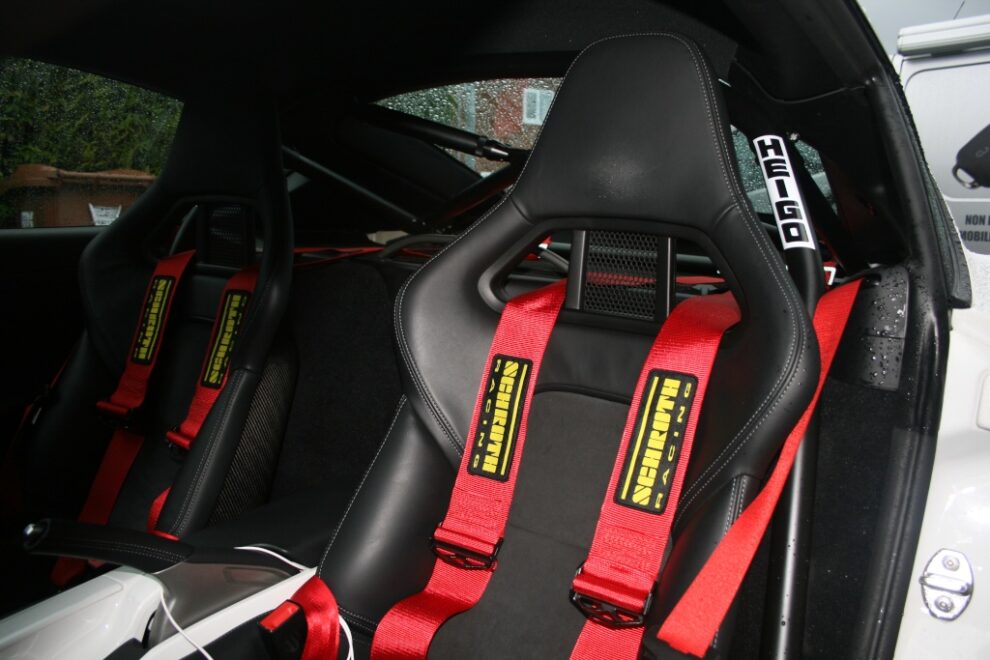
Red Schroth harnesses with yellow logo pads on black bucket seats in a car with a roll cage
Red Schroth harnesses fitted in a customer car. The approval labels sit on the webbing.

Because the labels are the proof, look after them. Do not cut them off, cover them with pads that cannot be moved, or let them wear away. A harness with a missing or unreadable label cannot show what it is approved to, whatever it says on the receipt.

If anyone asks to see the approval, show them the label. If you need more than that, ask us and we will pass the question to Schroth.

Identifying a road approved Schroth harness

Schroth sell harnesses for the street, for competition, and some for both. These are the things to check:

1. The label. This is the only certain answer. Look for the E mark. If there is only an FIA label, the harness is approved for motorsport, not the road.

2. The model line. Schroth group their street legal harnesses together on their own site. The Rallye 4 ASM is listed there with ECE and FMVSS homologation, and the Profi II-FE ASM is listed with FIA and ECE-R 16.04 approval.

3. The buckle. Road approved Schroth harnesses use a push button buckle, like a normal seat belt. On the Profi II-FE, the FE push button buckle is the part that passes road approval; the standard Profi II, with its aircraft style buckle, is FIA approved only.

4. Do not go by ASM alone. ASM is Schroth’s anti-submarining system: one shoulder strap is built to lengthen differently from the other in a frontal impact, which helps keep the pelvis in the seat and under the lap belt. It is on Schroth road harnesses and on their FIA four points too. The Clubman II ASM, for example, is an FIA 8854-1998 harness with no road approval. So “ASM” in the name tells you about the design, not the approval.

5. The listing. On our site the approval is listed on each Schroth harness. If it is not clear, ask before you order.

FIA and ECE: what the difference means in practice

ECE R16FIA
What it is forRoad vehiclesMotorsport
Who checks itYour testing station and insurerThe scrutineer at the event
Typical layout3 or 4 point, push button buckle4, 5 or 6 point, cam lock or lever buckle
ExpiryNo expiry year on the label; check for wearLabel carries a "not valid after" year
On the labelE mark and approval codeFIA homologation number and year

Road harnesses are built to live with a normal car. They are usually three or four point, with a push button buckle, and many are designed to use the car’s own seat belt anchorages. Schroth’s Rallye harnesses are made that way, and on some cars they sit alongside the original belt.

FIA harnesses are built for a competition seat and a caged or harness bar equipped car. Most are five or six point, with a cam lock or lever buckle. Each FIA label carries a year after which the harness is no longer valid for competition, and your championship’s regulations say which approvals and dates are accepted. Our guide to how long FIA harnesses last goes through the labels in detail.

Dual approved harnesses carry both labels. In the Schroth range on our site, the Profi II-FE ASM and the Lotus II-FE ASM are listed with both FIA and ECE approval. They suit a car that is driven on the road and used at events, as long as the car and the fitting are accepted for both.

Schroth harnesses on our site

We list a wide Schroth range, and the approval is on every listing. Roughly, it splits three ways:

  • Road harnesses. The Rallye 3 ASM and Rallye 4 ASM, and Schroth’s QuickFit harnesses, which are made for specific cars such as the BMW E46, and which our listings mark for road and track.
  • Dual approved. The Profi II-FE ASM and the Lotus II-FE ASM for the Elise and Exige Series 1 and 2.
  • Competition. The Clubman II ASM and Profi II ASM four points, and the Profi, Enduro and Clubman six points.

Garreth’s advice is to decide first how the car will be used, then choose the approval, then the harness. A road car that does the odd track day and a car built for a championship need different things. If you are planning the install, our guide on how to fit a motorsport harness covers anchor points and angles, and our top three point road harnesses post covers the simplest road option.

Before you fit one

  • Check the label shows the approval you need, and that it is readable.
  • Read Schroth’s instructions for the anchorage positions and strap angles before you drill anything.
  • Ask your testing station about the car and the fitting if it is a road car, and tell your insurer about the modification.
  • For competition, read your championship’s rules and ask the scrutineer if anything is unclear.
  • Keep the harness as supplied: do not mix buckles, straps or fittings from another harness.

If you are unsure which Schroth harness suits your car, send us the car, the seats and how it is used, and we will talk it through.

No. There is no separate paper certificate; the approval is shown on the labels sewn into the harness webbing.

Look for the E mark label on the webbing. A harness with only an FIA label is approved for motorsport, not the road.

No. ASM is Schroth’s anti-submarining design and is found on FIA only harnesses such as the Clubman II ASM as well as road harnesses.

On our site, the Profi II-FE ASM and the Lotus II-FE ASM are listed with both approvals.

That depends on the car, the seats and the fitting, so ask your testing station and tell your insurer before you fit one.

💬
Road and trackSchroth Profi II-FE ASM

FIA and ECE approved, with the FE push button buckle, for a car that does both.

Need a personal recommendation?

We're here to ensure you pick the right seat. Contact us today.
Our showroom virtual walk through!
Have a walk around our showroom before you even buy your new seats. 
Our hands on experience, is what allows us to bring you our recommendations.
Free UK Shipping

On all orders above £100

Showroom

Try before you buy, by appointment

Delivery Tracking

Updates by email and text