Call Garreth, Cameron & Jack: 0115 647 8650

FREE UK shipping on orders over £100.00 & FREE gifts on checkout

Your garage NewAdd your car and see the parts that fit
Useful Links
Your Account

Talk to us

Garreth, Cameron & Jack · Mon to Fri
Call 0115 647 8650Free advice on your build
Thanks, that’s with us. We reply the same working day.
That didn’t send. Please give us a call instead.

Useful Links

Quick Access

Want to chat?

Call Garreth, Cameron, Jack
Today On: 0115 647 8650
Click Here For Our Contact Form


Customer Question: Can I Use a 5/6 Point Harness With a Standard Seat or Recliner?

Harness and seat guide

It is one of the questions we are asked most: can I fit a 5 or 6 point harness to my standard seat, or to a reclining sport seat? Our answer is no. A 5 or 6 point harness is made to work with a fixed back bucket seat and proper harness mounting points, and fitted to the wrong seat it can do more harm than good.

It is easy to assume a racing harness is automatically safer. This guide explains why a standard or reclining seat is the wrong partner for one, what can go wrong, and the safer options if you want more support in a car that keeps its road seats.

  • 5 and 6 point harnesses are made for fixed back bucket seats
  • Standard and reclining seats lack the slots and shape to route the belts correctly
  • A recliner's hinge is a weak point under harness loads
  • The wrong setup risks spinal compression and submarining
  • For a car keeping its reclining seats, a 3 point or ASM 4 point road and track harness is the safer upgrade
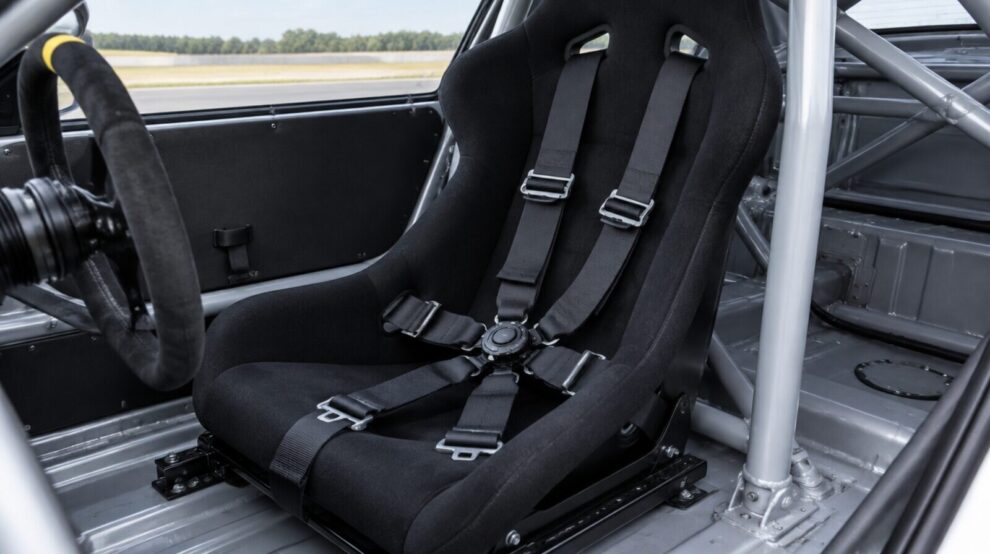
A black fixed back bucket seat with a six point harness fitted in a caged race car
A fixed back bucket seat with a 6 point harness in a caged car. A general photo, not a specific product.

Why standard and reclining seats are the wrong partner

A 5 or 6 point harness is there to hold the driver firmly in the seat, both through fast corners and in an impact. It can only do that if the seat is built to guide the belts to the right place. Standard seats and reclining sport seats are not. There are three main problems.

  • No harness slots. A fixed back bucket seat has openings at the shoulders, hips and crotch so each strap sits where it should. A standard seat has none, so the belts go round or over the seat at the wrong angles.
  • The wrong angles. Harness shoulder straps need to run back from the shoulders at the right angle to the mounting point. A road seat’s shape and height rarely allows that, and a strap at the wrong angle can load the spine in a frontal impact or fail to hold the driver.
  • The reclining hinge. A recliner has a hinge mechanism where the back meets the base. A fixed back seat has no such joint. In an accident, the load a racing harness puts through the seat can be enough to make a recliner’s back give way.

Look at a typical reclining sport seat and you can see the problem. The adjustment knob and hinge sit at the base of the backrest, and the seat has no openings for crotch straps. Some reclining seats do have shoulder belt openings, but that is not the same as being designed for a full racing harness.

A recliner is designed around the car's own 3 point belt, and that is the belt it should be used with unless the seat maker says otherwise.
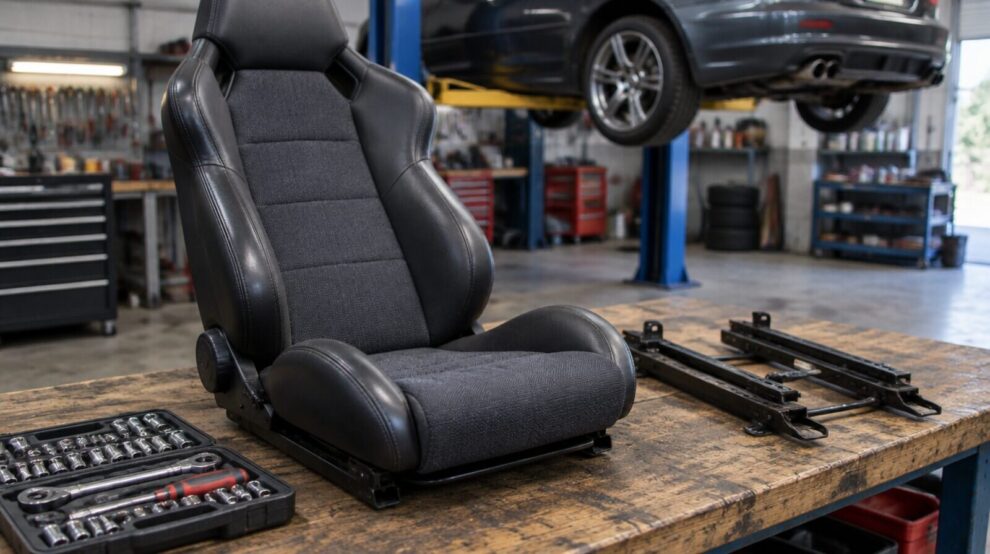
A black reclining sport seat with its runners on a workshop bench
A reclining sport seat and runners on a bench. A general photo, not a specific product.

What a fixed back bucket seat gives you

Harnesses are designed around fixed back competition seats, usually FIA homologated, which are built to take the loads of racing and of an impact. They bring four things a road seat cannot:

  • A reinforced shell designed to take the load a harness puts through it in a crash.
  • Built in harness slots that put the shoulder, lap and crotch straps in the correct place.
  • A rigid back, with no reclining hinge to fail under load.
  • FIA homologation on competition seats, which motorsport rules ask for.

If you want a 5 or 6 point harness for track use, the seat comes first. Pairing the harness with a proper bucket seat is the only correct way to use it.

What can go wrong with the wrong setup

A harness only protects the driver when the whole system, seat, belts and mounting points, is designed to work together. Fitted to a standard or reclining seat, a 5 or 6 point harness brings real risks:

  • Spinal compression. Shoulder straps running at the wrong angle can push down on the spine in a frontal impact.
  • Belts that slip. Without slots to hold them, shoulder and lap belts can move out of position when they are needed most.
  • Seat failure. A reclining seat’s back is not built for harness loads and can collapse in an accident.
  • Submarining. The crotch straps need a bucket seat’s shape to keep the pelvis in place. Without it, the driver can slide under the lap belt in a crash.

For all of these reasons, 5 and 6 point harnesses should only go into cars with fixed back bucket seats and proper harness mounting points.

Safer options if you are keeping your road seats

If the car is keeping its standard or reclining seats, there are better ways to add support than forcing a racing harness onto them.

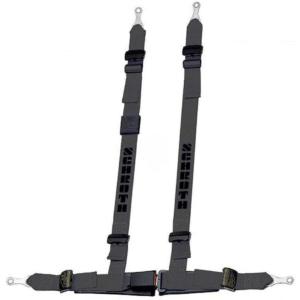
  • An ASM 4 point harness. Some manufacturers make 4 point harnesses with Anti-SubMarining (ASM) technology for road and track use, such as the Schroth Rallye 4. The ASM loop is sewn into one shoulder belt so the pelvis is pushed down into the cushion instead of sliding under the lap belt. They are not a substitute for a competition setup, but they suit fast road and track day cars. Check with us, or the maker, that your seat and mounting points suit one first.
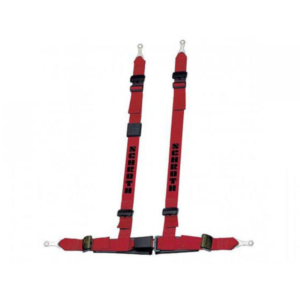
  • A better 3 point harness. Upgraded 3 point belts, such as the Schroth Rallye 3 ASM, are designed to work where a 4 point cannot, for example when a rear seat is too close for good strap geometry.
  • A fixed back bucket seat. If you really want a racing harness, fitting a proper bucket seat is the safest and only correct route.

Matching the seat to the harness

The seat and harness have to be chosen together. This is how we match them for customers:

Seat typeHarness typeWhere it suits
Standard road seatThe car's 3 point seat beltRoad use
Reclining sport seat3 point belt, or an ASM 4 point where the seat and car suit itRoad and fast road; not for competition
Fixed back bucket seat, not FIA4 point harnessTrack days
Fixed back FIA bucket seatFIA approved 5 or 6 point harnessMotorsport

Garreth’s advice is to decide how the car will really be used first: road, track days or competition. That settles the seat, and the seat settles the harness. Our list of common questions about bucket and racing seats covers more of the basics.

No. A 5 or 6 point harness is designed for a fixed back bucket seat with harness slots, and a recliner’s hinge is not built for harness loads.

No. A standard seat has no harness slots, so the straps cannot be routed at the correct angles and can hurt the driver in an impact.

Submarining is when the driver slides under the lap belt in a frontal impact. Crotch straps in a proper bucket seat, or ASM technology in some 4 point harnesses, are designed to prevent it.

A 3 point belt, or an ASM 4 point road and track harness where the seat and car suit it. Ask us before ordering.

A fixed back bucket seat with harness slots, usually FIA homologated if you compete.

💬
The rule we followSeat first, harness second

A 5 or 6 point harness belongs with a fixed back bucket seat and proper mounting points.

Need a personal recommendation?

We're here to ensure you pick the right seat. Contact us today.
Our showroom virtual walk through!
Have a walk around our showroom before you even buy your new seats. 
Our hands on experience, is what allows us to bring you our recommendations.
Free UK Shipping

On all orders above £100

Showroom

Try before you buy, by appointment

Delivery Tracking

Updates by email and text