

Choose the seat before the bracket
The rig can be adjusted. Your body cannot. Start with a shell that supports your hips, thighs and shoulders for the length of session you drive, then choose brackets that join that exact seat to the exact cockpit.
The best sim seat is one you can sit in for the full session without bracing against the wheel or escaping a pressure point. Check the driver first, the outside shell second and the mounting interfaces third. FIA approval is optional for a static rig.
Side-mount holes, threads and positions vary by seat. Rigs also differ in profile width, cross-member spacing and included hardware. Check both drawings before buying, even when a bracket is described as universal.
The seat has to last longer than a showroom sit
Use the normal pedal and wheel position while checking support.
01Hips and thighs
Sit against the back padding. The base should locate the pelvis without hard pressure or forcing the knees inward.
02Torso and shoulders
Check the backrest curve and shoulder width. A shell can fit at the hips and still roll the upper body forward.
03Heat and pressure
Stay seated for fifteen minutes or more. Removable cushions can tune small gaps, but they should not hide a shell that pinches.
Cameron sees the same mistake on rigs and road cars: buying from trouser waist and height alone. Two drivers with the same numbers can need different shells because their torso length and hip shape differ.
And bigger is not always kinder. If the seat lets you slide sideways, your arms and legs do extra work every lap.
Match the outside shell to the rig
Measure the clear space and every interface under the seat.
Identify the cockpit and revision
Manufacturers alter cross-members, brackets and hardware. A model name without its age can point at the wrong manual.
Measure clear width
Check between the profiles at base height and around the shell shoulders. Include bolt heads and adjustment handles.
Identify the mounting route
Side-mounted shells use brackets beside the seat. Base-mounted and reclining seats need a plate, rails or an adaptor underneath.
Compare the drawings
Match hole location, thread, slot range and hardware length. Do not reduce the check to one front-to-rear number.
Check movement
Where runners or tilt adjustment are used, move the seat through the whole range and look for contact with the rig.
Garreth can usually identify the next part from a clear picture of the cross-members and profiles. Add a tape measure across the usable width and include any existing slider.
Fixed shell or reclining seat?
The answer depends on how the rig is used between races.
Fixed bucket seat
Firm postureSide or base mounting depending on model- Stable backrest under heavy pedal pressure
- Many shell shapes and padding layouts
- Can sit low on side mounts
- Harder entry if the wheel does not move
Reclining sport seat
Easy adjustmentUsually base mounted- Backrest angle changes without tools
- Useful when the rig doubles as a desk
- Easier access for different drivers
- Hinge and runners can add movement
A fixed shell is not automatically uncomfortable, and a recliner is not automatically soft. Padding density, base angle and the shape behind the lower back decide more than the hinge.
Sim-specific or competition seat?
Spend on the parts you will use, but keep future plans honest.
| Seat choice | Makes sense when | Check before buying |
|---|---|---|
| Sim-specific fixed shell | The seat will stay on a static cockpit | Mounting drawing, shell dimensions and padding layout |
| FIA competition seat | You want the same seat and posture as the car, or may move it later | Label, date, permitted supports and event rules |
| Non-homologated motorsport-style shell | You want a fixed shape without competition approval | Construction, mountings and clear statement that it is for the rig |
| Road-car recliner | The rig is shared or used for desk work | Base pattern, runner support, weight and backrest clearance |
A similar outline or shared manufacturer does not give a non-homologated product competition approval. If the seat is later moved into a car, assess it again for that vehicle and use.
Set the controls around the supported driver
Seat angle changes every reach and sight line.
Set the base and back angle
Choose a posture that keeps the pelvis against the seat and supports the upper back without pushing the head forward.
Move the pedals
Leave a bend in the knee at full brake travel and keep the hips from lifting under pressure.
Set wheel distance
With shoulders against the seat, the driver should reach the wheel without straight elbows or a rounded back.
Check screens and head position
Set the eyeline after the seat is fixed. Do not tilt the body to correct a screen mounted too high or low.
Drive a full stint
Small pressure points and reach problems appear with time. Adjust one thing at a time so the change is clear.
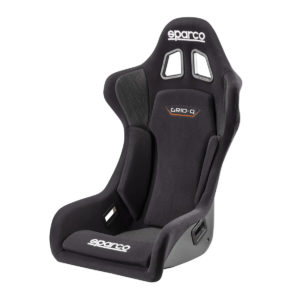
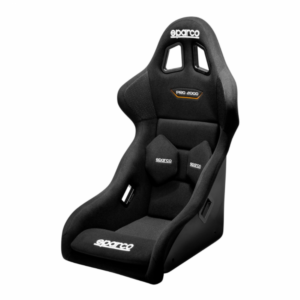
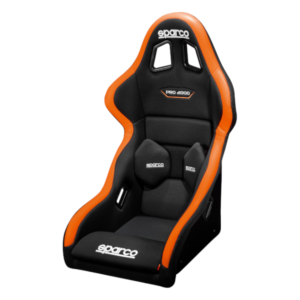
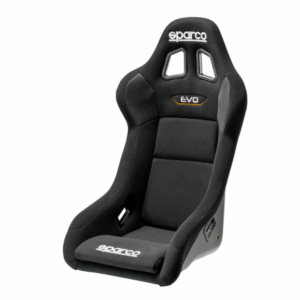
Sim-seat examples
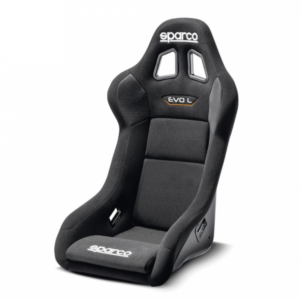
Different shells and driving positions from the current category. Check each product drawing and fit.
-
From £458.40 Incl. VATFrom £382.00 Excl. VATPayPal CreditKlarna ReadySelect options This product has multiple variants. The options may be chosen on the product page
-
From £564.00 Incl. VATFrom £470.00 Excl. VATPayPal CreditKlarna ReadySelect options This product has multiple variants. The options may be chosen on the product page




Questions about sim-racing seats
Do I need an FIA-approved seat on a simulator?▾
No for a static simulator. FIA approval matters if the same physical seat will later be installed in a competition car. Keep the label, permitted supports and remaining date in mind before moving it between uses.
Will every side-mounted seat fit my rig?▾
No. Check the seat hole positions and threads, bracket slots, profile spacing, outside shell width and supplied hardware. Multi-hole brackets cover many combinations, not every seat and cockpit.
Is a reclining seat better for long sessions?▾
Sometimes. A recliner makes entry, desk use and angle changes easier, but it can move more under heavy braking. A correctly shaped fixed seat may be more comfortable for a long stint. Try the seat rather than choosing from backrest type alone.
Should I choose a larger bucket seat for comfort?▾
Not automatically. A shell that is too large stops supporting the hips and torso. Compare seated hip width, thigh shape, torso length and pressure points. Another shell shape often fits better than the next size up.
Do runners make the rig flex?▾
They add another moving interface, so quality, support and adjustment matter. Runners are useful on a shared rig or where sliding back helps entry. A single-driver rig can be fixed if the position is already known.
Can I fit a real harness to a simulator?▾
Yes where the rig has suitable attachment points, but on a static rig it is for driving position or immersion, not a road or competition safety claim. Do not route straps over sharp profile edges.
What measurements do you need?▾
Send seated hip width, shoulder width and torso height, plus the clear width between rig uprights, mounting-rail spacing and photographs of the seat area. Name the cockpit and revision if known.
Can I use a road-car seat?▾
Yes if the rig has or can accept a suitable base mount. Check the underside mounting pattern, runner arrangement, final height and backrest clearance. Heavy electric seats need much more support and power planning.
We will check the joining parts
Give us the cockpit model, revision, clear profile width and the seat you are considering. Add driver measurements and Garreth or Cameron can narrow the shell choice as well.
Browse sim seatsCall 0115 9893488Contact usBrowse FIA seats