
Complete Guide to Schroth Indi Seat Insert Kits and Fire Safety Standards
Seat insert guide
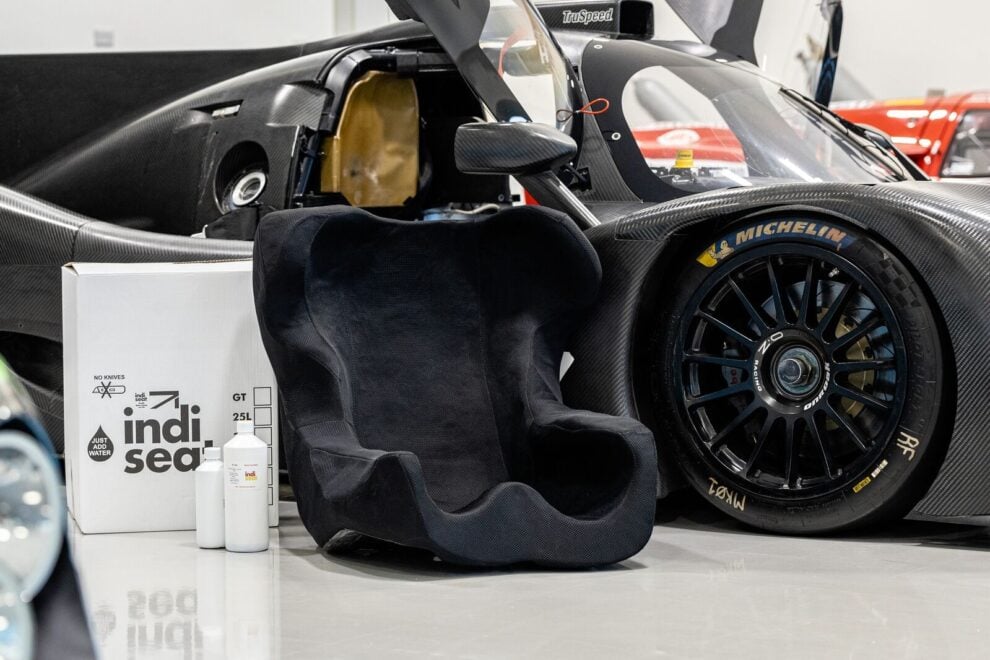
A bead and resin seat kit lets you mould a seat around your own body, in your own car. You sit in your driving position, the bag of beads shapes itself around you, a vacuum holds that shape and the resin sets it hard. What you end up with fits one driver in one cockpit, and nothing else will fit you quite as closely.
We sell the Schroth iNDi kits and the Schroth Profi Seat Kit, which use the same principle. This guide explains how they work, which size to choose, how a seat is made, how it compares with foam, and what we can and cannot tell you about fire safety.
- A bag of impact absorbing beads and resin, shaped around the driver under vacuum
- Schroth quote a 30 minute cure for the Profi Seat Kit resin
- iNDi kits are listed in 30, 40, 50 and 70 litre sizes; the Profi Seat Kit in 25 to 70 litres
- One kit makes one seat for one driver in one car
- Schroth describe the finished Profi Seat as flame resistant
- Your scrutineer and your championship's rules decide what is acceptable in competition
What is on this page
What a bead and resin seat kit is
The kit is a strong bag with a valve, filled with small impact absorbing beads. You mix the resin as the instructions say and add it to the bag, the bag goes into the seat or the seat aperture of the car, and the driver sits on it in their normal driving position, wearing what they race in. A vacuum draws the air out, which pulls the beads tight around the driver’s back, sides and legs. When the resin cures, that shape is locked in.
It can be used two ways. In a car with a homologated seat shell, the moulded piece becomes an insert that fills the gaps between you and the shell. In single seaters and prototypes, where there is often no conventional seat at all, the moulded piece is the seat, made to sit against the tub.
Schroth list professional programmes that use their Profi Seat, among them F1, NASCAR, GP2, BTCC, NHRA, F3, GP3 and LMP, and the same system is used at club level from Formula Ford to Caterhams and Radicals. At every level the reason is the same: the closer the fit, the less you move, and the less you move, the more consistent and less tired you are.
Why drivers use one
- Fit. No off the shelf seat is shaped exactly like you. A moulded seat supports your hips, back and shoulders where you actually touch it, so you stop bracing yourself in corners.
- Consistency. You sit in exactly the same place every time you get in, which helps with pedal reach, steering and your view out.
- Fatigue. Less movement and even support make long stints easier.
- Durability. Once cured, the bead and resin structure keeps its shape. Foam can compress or break down over a few seasons.
The limit is that the seat belongs to one driver in one car. If two drivers share the car, each needs their own kit and their own seat, and a seat moulded for one car will not transfer to another without making a new one.
Fire safety: what we can tell you
Anything in a race car cockpit should add as little as possible to a fire, and a seat or insert sits right against the driver, so it is a fair question to ask about any kit. Here is what the sources say.
Schroth describe the finished Profi Seat insert as flame resistant. That is the maker’s description. We have not seen test paperwork for it ourselves, so we do not add any claim of our own to it.
Most people finish the moulded seat with a cover. Cover material for these seats is sold separately, and the kit contents Schroth list for the Profi Seat Kit do not include one, so plan to buy it separately if you want a covered finish.
What we will not do is tell you a moulded seat is legal for your car. Seat rules differ between championships and change over time. Before you make a seat for competition, check your championship’s regulations and ask your scrutineer, and keep the kit’s instructions and paperwork with the car.
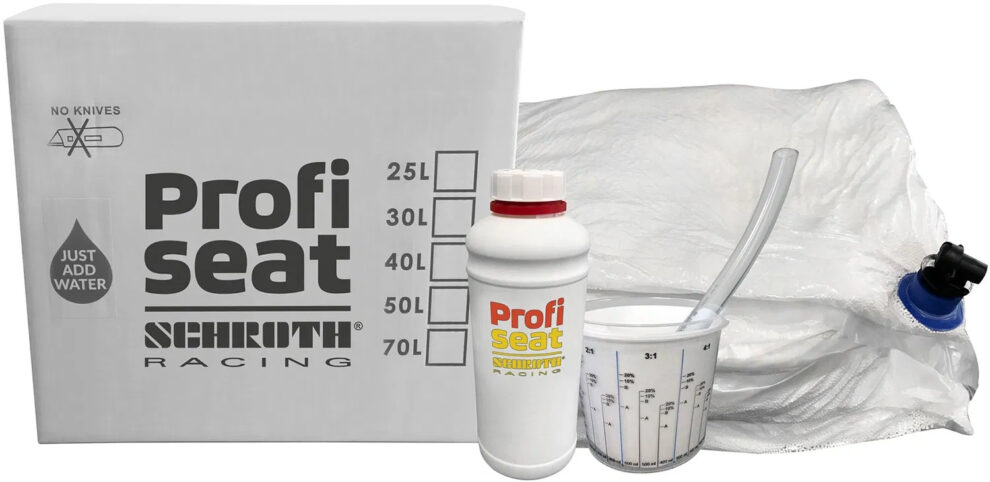
Schroth list the Profi Seat Kit contents as the vacuum bag with valve and filter, the impact absorbing beads, resin with a colour dye, a funnel, a mixing jug, a hose for the vacuum, the instructions and a key points sheet.
The colour dye is there so you can see when the resin is mixed evenly through the beads. You will also need a vacuum source, a helper, and time in the car with nobody rushing you.
Choosing a size
The litre figure is the volume of the bag, which roughly decides how big a seat you can make. The right size fills the space around the driver and against the shell or tub without excess. Too small and you end up with thin sections of support on one side. Too full and the bag pushes against you instead of supporting you.
| Size | Usually suits |
|---|---|
| 25 to 30 litres | A compact driver, a narrow cockpit, or an insert filling modest gaps in a shell |
| 40 to 50 litres | A medium build driver, a typical single seater or narrow sports car seat aperture |
| 70 litres | A larger driver or a wider installation with more space to fill |
A good way to judge it is to sit in your current seat and look at how much empty space there is around you, especially at the sides of the hips and behind the lower back. If you are between two sizes, the larger kit is usually the safer choice. Garreth’s advice is to tell us the car, the seat or tub it is going in, and your height and build, and we will suggest the size.
How a seat is made
- Prepare the car and the driver. Set the steering wheel and pedals where they will be. The driver wears their suit and, ideally, their helmet and harness, so the seat is shaped around the real driving position.
- Protect the seat or tub. Line it as the instructions describe, so the cured seat comes out cleanly.
- Mix the resin. Follow the kit’s instructions exactly for quantities, and use the dye to check the mix is even through the beads.
- Sit and shape. Put the bag in place, sit in your natural position, and have your helper draw the vacuum. The beads pull in around you. Settle, check your reach, and hold still.
- Let it cure. Schroth quote 30 minutes for the Profi Seat Kit resin. Do not move until it has set.
- Trim and finish. Remove the seat, trim the edges, cut any harness slots in line with the shell’s slots, and cover it if you are using a cover.
This video from HMS Motorsport shows a Schroth Profi Seat Kit being made from start to finish, which is the best way to see the stages before you try it.
Bead and resin against expanding foam
Expanding foam seat kits have been around for years and some drivers still use them. The main practical difference is time. Foam starts to grow and set quickly, which leaves little room to get the position right. A bead kit is shaped under vacuum and you can check and adjust before the resin cures.
The finished bead seat also holds its shape well over time, where foam can shrink or become brittle. Whichever you use, the same rules apply: make it in your real driving position, cover and finish it properly, and check it is acceptable for your championship.
What is a Schroth iNDi seat kit?
A bag of impact absorbing beads and resin that is shaped around the driver under vacuum and cured, making a seat or insert for one driver in one car.
What sizes are there?
The iNDi kits are listed in 30, 40, 50 and 70 litres, and the Schroth Profi Seat Kit in 25, 30, 40, 50 and 70 litres.
How long does the resin take to cure?
Schroth quote 30 minutes for the Profi Seat Kit resin.
Is the moulded seat fire resistant?
Schroth describe the finished Profi Seat as flame resistant. Check your championship’s rules and ask your scrutineer before using one in competition.
Can two drivers share one moulded seat?
No. It is shaped around one driver, so each driver needs their own kit.
💬
Not sure of the size?Tell us the car and the driver
Send us the seat or tub, your height and build, and we will suggest the kit.
Need a personal recommendation?
We're here to ensure you pick the right seat.
Contact us today.
