Call Garreth, Cameron & Jack: 0115 647 8650

FREE UK shipping on orders over £100.00 & FREE gifts on checkout

Your garage NewAdd your car and see the parts that fit
Useful Links
Your Account

Talk to us

Garreth, Cameron & Jack · Mon to Fri
Call 0115 647 8650Free advice on your build
Thanks, that’s with us. We reply the same working day.
That didn’t send. Please give us a call instead.

Useful Links

Quick Access

Want to chat?

Call Garreth, Cameron, Jack
Today On: 0115 647 8650
Click Here For Our Contact Form


Choosing a sim seat for a 42-inch waist

“Which bucket seat will fit me at a 42-inch waist?” Start with the wider seats, then check the hip space, backrest and rig together. A trouser size alone cannot settle the fit.

Our shop currently lists the Sprint L, TRS-E XL and WRC-R XL in waist bands reaching 42 inches. This guide keeps the five models from our April 2025 comparison, with current product links and fitting checks. The Evo XL and Titan XL need separate consideration; an XL badge is not a shared size.
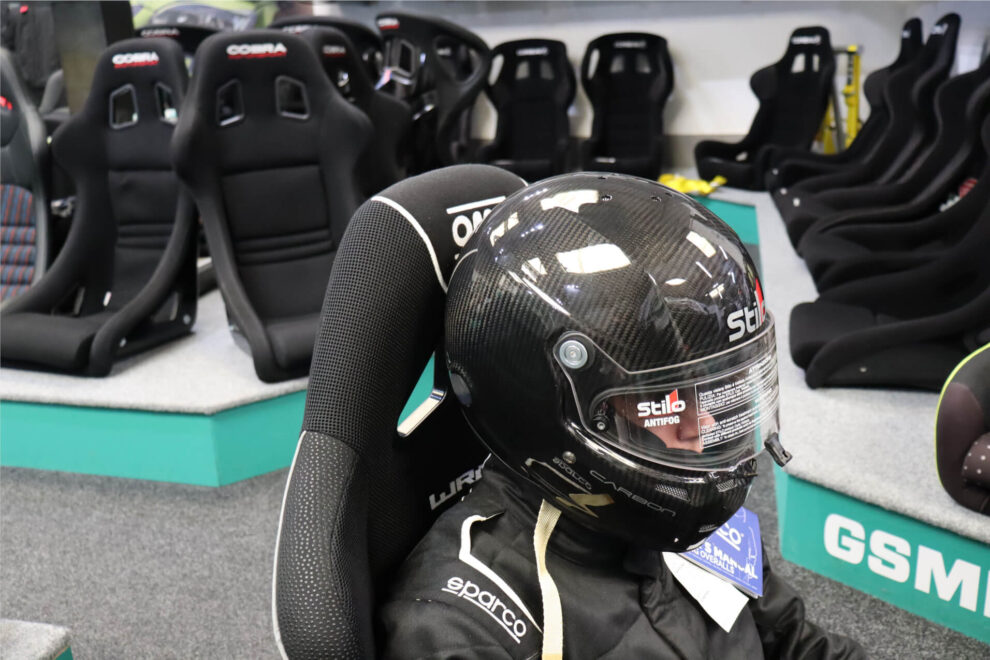
A mannequin in a Sparco race suit and Stilo carbon helmet sitting in an OMP WRC-R bucket seat in the GSM Performance showroom, with rows of bucket seats behind
An OMP WRC-R on our showroom display. This photograph does not establish the XL size or confirm what is available to try today.

Why fit a motorsport seat to a sim rig

A fixed-back motorsport seat can give a sim driver a stable position under braking and a choice of shell sizes. It still needs to suit your body and the position of your wheel, pedals and screen.

  • Hip room: check the usable space between the bolsters, with the cushions fitted.
  • Backrest: check shoulder support and reach while seated, including whether the side bolsters obstruct your arms.
  • Rig layout: allow for the seat, brackets and any slider when setting pedal distance and wheel height.

Stop a trial if the bolsters pinch or you develop numbness. A racing shape does not guarantee comfort through a long session, and changing shell material will not correct the wrong size.

Steel framed seats

These two seats use tubular steel frames, but their mounting options differ.

1. Sparco Sprint L. Our listing gives a 40–42-inch waist guide. Sparco calls the current BRR0005B0K0100N model Sprint+ L and identifies a tubular frame, FIA 8855-1999 homologation and no integrated head-restraint wings. The catalogue confirms both lower and lateral fixing.

The 2026 Sparco catalogue, printed page 182, specifies M8 lower fixing at 271 × 345mm and M8 side fixing at 290mm spacing. That gives you two fitting routes to check against the rig; neither guarantees that an existing seat plate or bracket clears the wider seat.
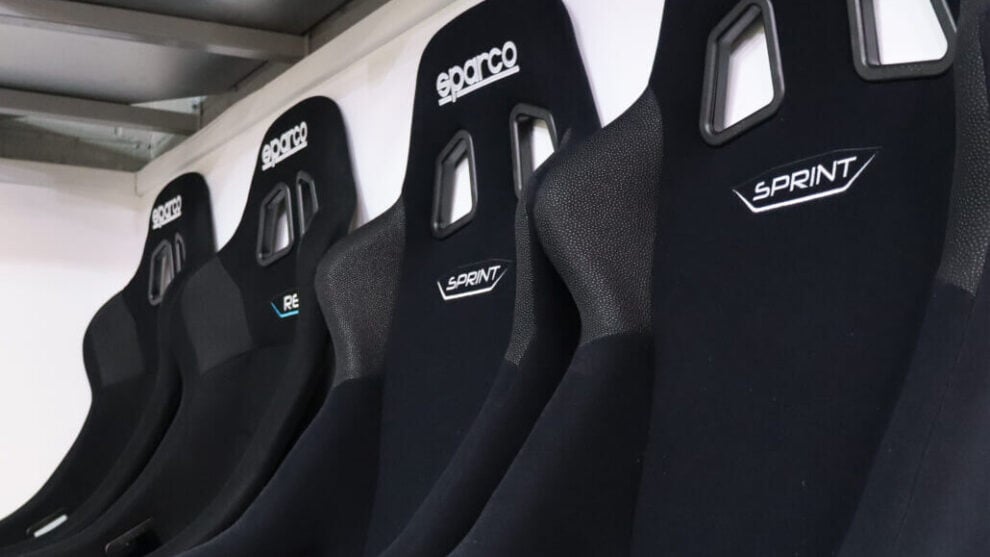
A row of black Sparco Sprint FIA bucket seats lined up on a showroom shelf
Sparco Sprint seats on a showroom shelf. Compare the actual L model and drawing when choosing your size.

2. OMP TRS-E XL. Our shop groups this seat in the 36–40 and 40–42-inch waist bands. OMP’s 2026 catalogue, printed pages 56–57, identifies the HA0-0781-B01 as a larger and higher TRS-E with velour trim, a removable cushion and a tubular steel frame. It lists 12.3kg complete, against 10.3kg for the standard TRS-E; these are manufacturer guide figures.

The XL has side fixing only. The standard TRS-E also has lower fixing, which is an easy detail to carry across to the wrong version. For the XL, check a side-mount arrangement for your rig before ordering.

Fibreglass seats

The three composite models below use side mounts; check their individual shapes and dimensions against your body and cockpit.

3. OMP WRC-R XL. This is the fibreglass option our listing groups up to a 42-inch waist. OMP’s current seat table, printed pages 62–63, identifies Airnet trim, split leg cushions, five harness openings and side fixing. It gives 415mm internal width at the belt-hole area for the XL, compared with 390mm for the standard WRC-R.

Those widths describe one labelled part of the seat, not your whole hip space. The same table gives different changes at the shoulders and backrest, so the old description “50mm taller and wider” is too simple. OMP marks its dimensions as guides that may vary in production.

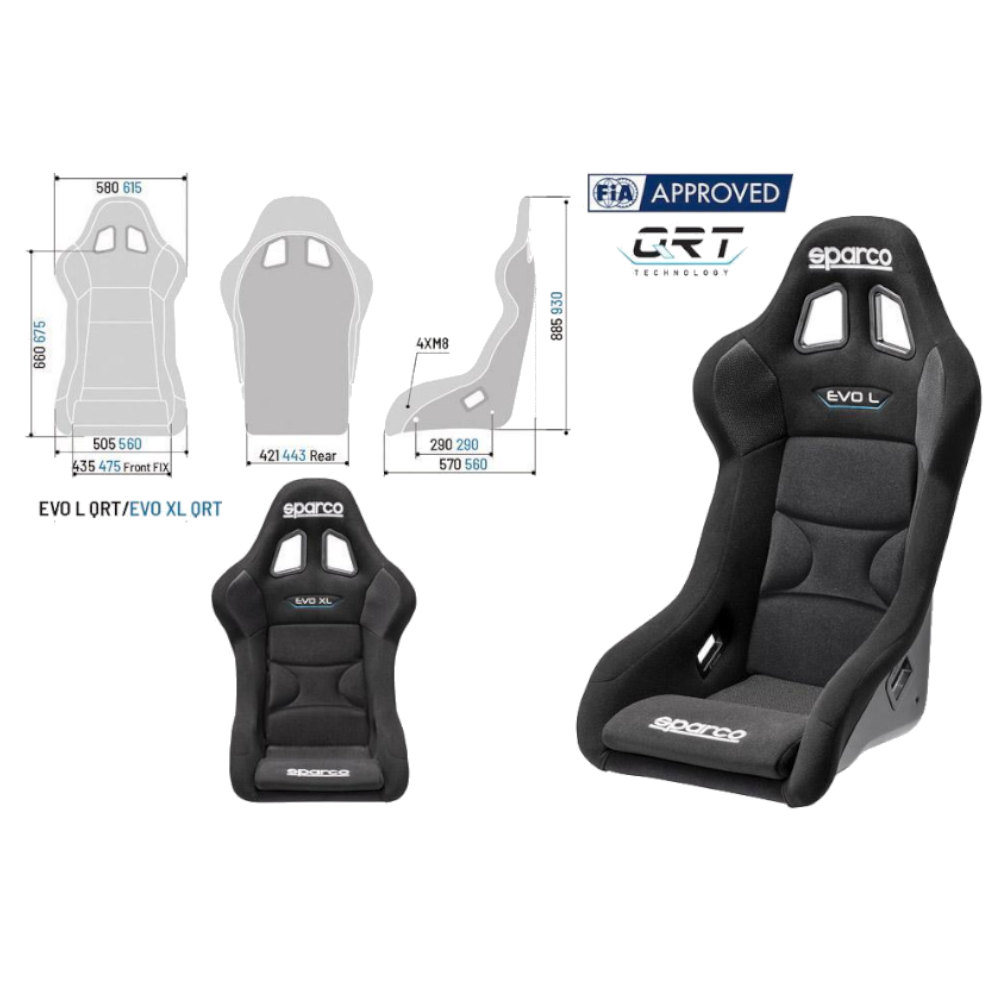
4. Sparco Evo XL QRT. The FIA model linked here is 008015RNR, with QRT construction and M8 lateral fixing at 290mm in Sparco’s current catalogue, printed page 177. Its current shop listing does not give a waist band. We also list a distinct Evo XL QRT sim racing version in the 36–40-inch band; that version is not FIA homologated.

At 42 inches, do not order the Evo XL on its name alone. Compare the exact version’s drawing and try the seat where possible; the sim version’s size guidance is below your stated waist. Neither the homologation nor a difference in price establishes more room.

5. Sabelt Titan XL. Our listing gives a 36–40-inch waist guide, so it is outside the stated band at 42 inches. Sabelt calls its current XL fibreglass model Titan Max, with 290mm side fixing, breathable trim, a 40mm separate leg cushion and a 20mm lower cushion.

Sabelt’s 2026 catalogue, printed pages 106–107, distinguishes 7.8kg shell weight from 9.9kg seat weight. Our listing’s SKU ends MAXM while the manufacturer’s current code ends MAXN; confirm the supplied revision and its drawing before using the current dimensions to plan a purchase. The high side bolsters do not form integrated head-restraint wings.

The five seats side by side

Shop waist bands are a starting point, not manufacturer fit guarantees
SeatConstructionShop waist guideMounting to check
Sparco Sprint LTubular frame40–42inLower 271 × 345mm or side 290mm
OMP TRS-E XLTubular steel frame36–42inSide only; exact OMP drawing
OMP WRC-R XLFibreglass36–42inSide only; exact OMP drawing
Sparco Evo XL QRTQRT compositeFIA listing: not stated. Sim listing: 36–40inSide only; check the exact version
Sabelt Titan XLFibreglass36–40inSide only, 290mm; confirm revision

Steel or fibreglass: which suits your rig

Choose the seat’s fitting route before comparing the bracket budget. The Sprint L offers lower or side fixing; the TRS-E XL and the composite models here need side fixing. A flat seat plate may accept an appropriate adaptor, but its dimensions and load limits still need checking with the rig maker.

On a side-mounted seat, check both joints: seat to bracket, then bracket to cockpit. OMP’s table labels its W side fixing at 289mm; Sparco and Sabelt show 290mm on the cited models. Check the actual drawing and bracket slots, their width range and the required fixings instead of promising a universal bolt-on fit.

For later related reading, our GT Omega and Sim-Lab upgrade guides discuss cockpit mounting routes. Use your exact chassis manual for the final installation; a guide covering a range does not establish every model’s clearance or included hardware.

Getting the fit right

Garreth’s starting question is which part of your present seat is too tight: the hips, thighs, shoulders or all three? Tell us that alongside your height and waist.

  1. Measure seated hip width at the widest point and compare it with the drawing’s labelled internal area. An external shell width is a different measurement.
  2. Check shoulder width and backrest height while reaching for the wheel.
  3. Measure the rig’s available seat width, bracket spacing and adjustment range, allowing for the slider if used.
  4. Try the proposed pedal and wheel position with the cushions fitted. Leave clearance around the bolsters and controls.
  5. Call before visiting to ask which exact sizes are currently available to sit in.

Cameron can help compare those details with the current seat and mounting drawings. Send the cockpit make, model and revision, photographs of its seat platform and your total budget including brackets. A drawing can narrow the choice; sitting in the actual seat remains the better fit check.

A static sim rig does not normally need an FIA-homologated car seat, though an organised event may set its own requirements. Keep gaming-only seats for their intended use. Moving any seat into a car later requires a fresh check of its approval, condition, label, supports and the rules for that use.

Our shop currently lists the Sparco Sprint L, OMP TRS-E XL and OMP WRC-R XL in waist bands reaching 42 inches. Those bands guide the shortlist; hip width, backrest fit and an actual seat trial still matter.

OMP specifies side fixing only for the TRS-E XL HA0-0781-B01. Do not transfer the standard TRS-E’s lower-fixing option to the XL. Check the side mounts and cockpit interface together.

Sparco’s current Sprint+ L catalogue entry specifies M8 lower fixing at 271 × 345mm, as well as 290mm lateral fixing. Check the actual seat revision and your cockpit’s plate, clearances and required hardware.

The current FIA Evo XL listing does not state a waist band. Our distinct Evo XL sim listing gives 36–40 inches, below a 42-inch waist. Compare the exact version’s drawing and try it before ordering; XL is not a universal size.

A static simulator does not normally require FIA car-seat homologation; check any organised event’s rules. A gaming-only seat is not a substitute for an approved car seat. An FIA label also does not guarantee comfort or cockpit fit.

Check the driver and the cockpit together

Send your measurements, exact rig model and bracket budget before choosing the seat.

Choosing a wider sim seat?

Tell us your measurements and exact cockpit so we can help check the options.
Our showroom virtual walk through!
Have a walk around our showroom before you even buy your new seats. 
Our hands on experience, is what allows us to bring you our recommendations.
Free UK Shipping

On all orders above £100

Showroom

Try before you buy, by appointment

Delivery Tracking

Updates by email and text