
Do We Part-Exchange Seats? Why We Don't Accept Used Seats
Your questions answered
One of the questions we get asked most is whether we part-exchange seats. The answer is no. We do not buy, trade or take in second-hand seats, and we do not accept any other used safety equipment either, such as harnesses.
We understand why people ask. Trading in the old seat would take a bit off the price of the new one. But a seat is part of what holds you in place in a crash, and once it has been fitted and used we have no way of knowing what it has been through. This page explains why that matters, what can go wrong with a used seat that looks fine, and what you can do with your old one instead.
- We do not part-exchange, buy or trade in used seats
- We do not take in any other used safety equipment, such as harnesses
- A used seat's history cannot be checked, and damage is not always visible
- Everything we sell is new, supplied through the manufacturer's distribution
- Selling privately is an option, but be honest about the seat's history
What is on this page
Why we do not accept used seats
The reason is safety. A racing or sport seat is designed to hold the driver in place and spread the loads in an impact. Once it has been fitted and used, nobody can be completely sure of its history. It may have been in an accident, dropped, bolted to badly made brackets, or stored somewhere damp and hot for years. None of that has to show on the outside.
If we took a seat in and sold it on, we would be passing that unknown on to the next customer. We are not prepared to do that, so everything we sell is new, supplied through the manufacturer’s own distribution, with the approvals and warranty that come with it from the maker.
The same goes for harnesses and any other part that is there to protect you. Webbing and buckles wear and age in ways you cannot judge by looking at them.
The damage you cannot see
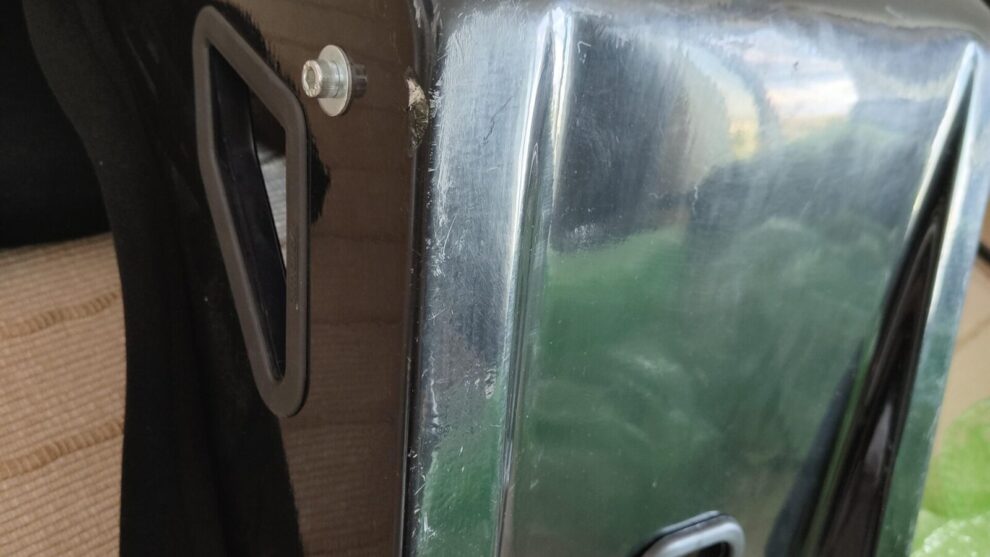
The photo at the top of this page shows the back of a used fibreglass shell. The scratches and the chip at the edge are obvious. What matters more is what is underneath, and that is the part you cannot inspect.
- Shells. Fibreglass and carbon shells can develop small cracks, especially around mounting points and harness slots. Steel framed seats can have bent or fatigued tubes inside the foam and cover.
- Foam and covers. Heat, sunlight and damp age the materials. Foam hardens or compresses, and fabric weakens.
- Mounting points. A seat that was fitted on the wrong brackets, or with the bolts overtightened, can have stressed or distorted mounting points.
A seat that looks good can still have any of these problems, and a seat that looks tired may be perfectly sound. The point is that without the full history, there is no reliable way to tell the difference from the outside.
FIA seats and their dates
If the seat is FIA homologated, there is a second question: its date. Each FIA seat carries a label showing the standard it meets and when it was made, and the length of time it can be used in competition depends on the standard and the rules of your championship. A used FIA seat may already be close to the end of its useful life for racing, even if it looks new.
Our guide to FIA 8855-1999 and FIA 8855-2021 seats explains the two current standards. If you are unsure whether a seat is still acceptable, your scrutineer is the person to ask.
Why part-exchange would put customers at risk
A part-exchange scheme only works if the seats taken in are sold again. If one of those seats then failed in an accident because of damage nobody could see, the person in it would pay the price. Selling only new seats removes that risk from the equation: you know where the seat has been, because it has come straight to you.
We would sooner help you find a new seat that fits your budget than sell anyone a seat with a past we cannot vouch for. Garreth’s advice, if price is the concern, is to tell us your budget up front, because there is a wide spread of new seats and the right one for your car may cost less than you expect.
What to do with your old seat
If you want to sell your old seats, a private sale is the usual route: owners’ clubs, motorsport forums and online marketplaces. If you do, be open about the seat’s age, condition and history, including any accident it has been in and the date on any FIA label, so the buyer can make an informed decision.
If a seat has been in an accident or has visible damage to the shell or frame, it is safest not to sell it on as a seat at all.
Do you part-exchange racing seats?
No. We do not part-exchange, buy or trade in used seats.
Do you accept used harnesses?
No. We do not take in any used safety equipment, harnesses included.
Why can a used seat be unsafe if it looks fine?
Damage such as cracks in the shell, a bent frame or stressed mounting points is not always visible, and a used seat’s history usually cannot be checked.
Where can I sell my old seats?
Privately, through owners’ clubs, forums or online marketplaces, being honest about the seat’s history and condition.
Can you help me find a new seat on a budget?
Yes. Send us your car, height, waist and budget and we will suggest options.
💬
Our ruleNew seats only
A seat is safety equipment, so we only sell seats whose history starts with you.
Need a personal recommendation?
We're here to ensure you pick the right seat.
Contact us today.
