

 Hundreds Of Products Ready Today. Dispatch/Collection
 Will You Save Weight by Switching to a Reclining Sport Seat?
When modifying a road or track-focused car, seat upgrades are often one of the first changes owners consider. Improved support, a sportier driving position, and interior styling all play a part. But weight reduction is frequently cited as a reason for switching seats, especially when moving away from heavy factory items. The key question is whether a reclining sport seat actually delivers meaningful weight savings, or whether expectations and reality are far apart.
Understanding where seat weight comes from
Factory seats are heavy largely due to complexity. Modern OEM seats often include electric motors, airbags, sensors, heating elements, and thick steel frames. It is not unusual for a standard road car seat to weigh 20 to 30 kg once rails and electronics are included.
Aftermarket reclining sport seats remove some of that complexity, but not all of it. The reclining mechanism itself requires reinforced hinges, locking systems, and additional steel structure to meet safety requirements. As a result, while lighter than many OEM seats, recliners still carry inherent weight penalties compared to fixed-back designs.
Typical weights in real terms
A common aftermarket reclining sport seat usually weighs around 13 to 15 kg for the seat alone. Once sliders and mounting brackets are added, the installed weight typically ends up in the region of 15 to 20 kg per seat.
Compared to a 25 to 30 kg factory seat, this represents a saving of roughly 5 to 10 kg per seat. Across both front seats, that equates to around 10 to 15 kg removed from the car. In performance terms, removing this amount of weight from the cabin is absolutely worthwhile and contributes to sharper turn-in, improved braking response, and a more agile feel overall.
Why reclining seats struggle to lose more weight
Reclining mechanisms and design
Reclining sport seats are designed to balance performance gains with everyday usability. The recline mechanism does add some weight, but it also delivers adjustability, comfort, and practicality that many road-driven cars still need.
For many builds, the goal is not absolute minimum weight but sensible, usable improvement. Reclining seats achieve this well. They reduce mass compared to factory seats, improve driver support, and retain flexibility for daily use. For mixed road and track cars, that balance is often exactly what customers are looking for.
How fixed-back seats change the equation
Fixed-back bucket seats remove the reclining mechanism entirely, allowing the seat to be built as a single structural shell. This simplicity opens the door to even greater weight savings.
A typical fixed-back composite seat shell often weighs around 7 to 8 kg. Once side mounts or base brackets are added, the installed weight usually sits around 10 to 12 kg per seat. Compared to a reclining seat at 18 to 20 kg, this can save a further 8 to 10 kg per seat. Against heavy factory seats, the saving can exceed 15 kg per seat.
For anyone focused on maximising performance, these numbers are significant. Removing 20 kg or more from the car through seat choice alone has a noticeable effect on handling balance, braking, and overall responsiveness.
Comfort and daily usability trade-offs
Weight is only one part of the decision. Reclining sport seats exist because many cars are still driven daily. Adjustability matters when multiple drivers use the car, or when long journeys are common. Being able to alter backrest angle, tilt the seat forward for rear access, or fine-tune posture can make a significant difference to comfort.
Fixed-back seats demand compromise. The seating angle is fixed, access can be awkward, and aggressive bolsters make repeated entry and exit less convenient. For some drivers, these drawbacks outweigh the performance benefit, especially in road-driven cars.
Track use and safety considerations
From a motorsport perspective, reclining seats have limitations. Adjustable backrests introduce a potential failure point in high-energy impacts. For this reason, reclining seats are not approved for FIA-sanctioned competition, while fixed-back seats can be homologated for racing use.
For casual track days or fast road driving, a high-quality reclining sport seat can still offer meaningful improvements over a standard seat. However, for competitive driving, fixed-back seats remain the accepted standard for strength, harness compatibility, and crash performance.
Real-world example: Honda Civic Type R FN2 seat upgrade
Reclining seat weight saving
The factory FN2 front seats weigh roughly 52 kg for the pair including rails, or around 26 kg per seat. Replacing them with a reclining sport seat such as the Sparco R100 reduces the seat weight to around 13 kg. Once sliders and brackets are added, the installed weight is typically around 18 to 20 kg per seat.
That represents a saving of roughly 6 kg per seat, or around 10 to 15 kg across both front seats. This is a strong result for a simple interior upgrade and one that many owners will feel immediately, especially when combined with improved support and driving position.
Fixed bucket seat weight saving
If weight reduction is pushed further, fixed-back bucket seats deliver even bigger gains. With installed weights around 10 to 12 kg per seat, the FN2 example shows how total seat weight can be reduced by more than 30 kg compared to factory seats.
This level of reduction is why fixed-back seats are the default choice for serious track and competition builds. They offer maximum support, rigidity, and weight saving in one upgrade.
Rigidity, safety, and track use
There is also a safety and rigidity aspect to consider. Reclining seats rely on a locking hinge, which is inherently a weaker point in high-energy impacts. For this reason, reclining seats do not carry FIA homologation for motorsport competition.
Fixed-back seats can be FIA approved and are designed to work correctly with 5- and 6-point harnesses and full motorsport safety systems. For customers planning track days only, a high-quality recliner can be perfectly acceptable. For anyone considering sprinting, racing, or rallying in the future, fixed-back seats are usually the required route.
Comfort and daily usability
Reclining seats still have a clear place, particularly in mixed-use road and track cars. Adjustability matters for long journeys, shared vehicles, and day-to-day comfort. Being able to change the backrest angle, tilt the seat forward in a 2-door car, or fine-tune posture makes ownership far easier.
Fixed-back seats demand compromise. The seating angle is fixed, access can be awkward, and aggressive bolsters make repeated entry and exit less convenient. For some customers, these trade-offs outweigh the performance benefit, especially if the car spends most of its time on the road.
Our top 5 best selling reclining sport seats
-
From £282.00 Incl. VATFrom £235.00 Excl. VAT Select options This product has multiple variants. The options may be chosen on the product page
-
From £282.00 Incl. VATFrom £235.00 Excl. VAT Select options This product has multiple variants. The options may be chosen on the product page

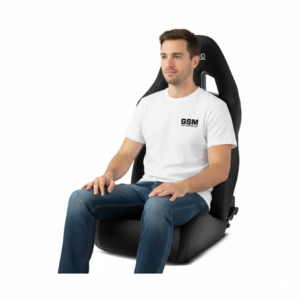


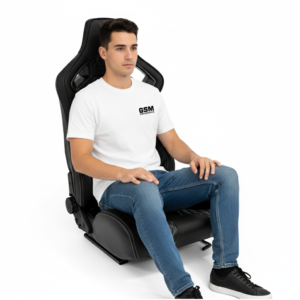

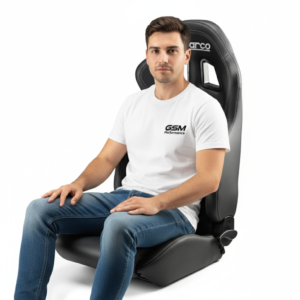
Got a question about the equipment we sell?
Why Choose Garreth And Cameron At GSM Performance?
So will you save weight by switching to a reclining sport seat?
Yes. Replacing heavy factory seats with reclining sport seats delivers a worthwhile weight saving, typically around 5 to 10 kg per seat. Every kilogram removed improves performance, and the benefits are multiplied by better support and driver control.
If your goal is maximum weight reduction and track-focused performance, fixed-back bucket seats take those gains even further. Both options deliver real benefits when chosen for the right application.
If you are unsure which seat type suits your car and how you use it, speaking to us directly can save time and ensure you get the best result. We can advise on real installed weights, correct brackets, slider options, seat height, and clearance issues based on proven installations.
We also publish vehicle-specific seat guides for many of the cars we support. These cover what fits, what does not, and seat combinations that work in the real world. They are a useful starting point when planning an upgrade and help make sure the seat you choose delivers the performance gains you expect.