
Head-restraint bucket seats
The wings beside the helmet are there to support the head in a lateral impact. They also take up room, affect visibility and make driver fit more critical. Choose one around the driver, cage and rules rather than buying the most enclosed-looking shell.
A head-restraint seat can be the right choice for rallying and circuit competition, but the shape alone proves nothing. Confirm the event requirement, approval label, specified mounts, driver position and clearance to the cage and door. A HANS or other FHR is separate equipment.
The seat supports the driver and helps manage lateral movement. A frontal head restraint is worn by the driver and connects to the helmet to control head movement relative to the torso in a frontal impact. One does not replace the other.
What the side-head supports do
They are part of the seat’s lateral support, not decoration and not a forward-restraint device.
01Pelvis support
The base and side bolsters locate the driver low in the shell. If the hips float around, the upper supports cannot rescue the fit.
02Shoulder support
The shoulder area should contain the torso without rolling the driver forward or leaving a large gap on each side.
03Side-head support
The wings help support the helmeted head laterally. Their height and gap need checking with the actual driving position.
Garreth’s quick check starts lower than most customers expect. If the base is wrong, moving straight to the impressive part around the helmet gives us a false answer. We sit the driver properly into the back of the shell, settle the shoulders, then look at the head supports.
The wings can also make getting in and out harder. In a car with a door bar or a narrow roof opening, that matters every time the driver straps in.
Fit the driver in race position
Use the helmet, suit and FHR the driver will actually wear.
Settle the pelvis
The driver should sit against the back padding with firm, even support. Hard pressure on the hip bones is not a close race fit; it is the wrong shape.
Check the shoulders
Make sure the shoulder supports do not force the upper body forward. Compare the driver with the harness openings at the final recline angle.
Put the helmet on
Check the eyeline and the gap to the side-head supports. The driver must be able to see mirrors, flags and the track without leaning out of the supported position.
Add the FHR
A HANS yoke changes the space around the neck and shoulders. Confirm the harness runs over it correctly and that the seat padding does not foul it.
Stay seated for a while
Pressure points that show after ten minutes matter. Do not assume a painful shell will become acceptable once the car is moving.
Going larger may fix one pinch but create room for the driver to move before the supports engage. Try another shell shape as well as another nominal size. Cameron often finds that a different backrest curve solves more than an XL badge.
The wings need space inside the car
Measure where the upper shell sits, not only the floor between tunnel and sill.
Measure and check
- Door and window clearance on the helmet side
- Cage bars, gussets, nets and padding
- Centre shoulder clearance in a two-seat car
- Roof opening during entry and exit
- Mirror view with the driver held in position
Do not rely on
- The base width by itself
- A photograph of the same car without its cage
- Driver height without torso length
- Removing seat padding to force clearance
- Mounting the seat off-centre without checking pedal alignment
A low-profile head-restraint shell can help where a full wing catches the door or cage, but low profile does not mean small driver. It describes the outside shape. We still need the internal dimensions and the driver’s seated position.
Leave clearance to hard structure and follow the FIA and cage-padding requirements. A seat touching the cage at rest is not an acceptable way of using the last millimetre.
The three FIA seat standards you will see
Read the exact championship rules before choosing between them.
| Standard | What it is | What to check |
|---|---|---|
| FIA 8855-1999 | The long-running competition-seat standard, with many open and head-restraint shapes | Current label, Technical List 12, remaining acceptance and permitted supports |
| FIA 8855-2021 | A stronger competition-seat standard with lateral pelvis, shoulder and head support requirements | Technical List 91 and the specific homologated supports |
| FIA 8862-2009 | The advanced seat standard with higher test loads and more complete lateral support | Technical List 40, homologated supports and any rear-bracket requirements |
FIA 8882-2009 is not a competition-seat standard. The advanced seat standard is 8862-2009. A frontal head restraint such as HANS is covered separately by FIA 8858-2010.
The FIA technical list may specify the support used with a seat, and the manufacturer instructions remain part of the installation. Do not move mounts from an older shell onto a newer one because the hole pattern happens to line up.
Check the seat against the FIA homologation and technical lists. Check a HANS or other FHR against the separate FIA head-restraint documents. Sources checked on 4 August 2026.
Mounts, harnesses and nets still have to agree
A correctly labelled shell can still be fitted badly.
01Seat supports
Use the support named by the technical list or permitted by the seat instructions. Check bolt grade, backing and vehicle attachment.
02Harness geometry
The shoulder, lap and anti-sub straps must use the intended openings and angles. Do not drag webbing over a wing or shell edge.
03Nets and cage
Where the rules require a racing net, use an approved arrangement and its installation instructions. The seat wing is not a net.
Head-restraint shells can reduce lateral space around the helmet, which is their purpose, but that does not give permission to crowd the seat against a cage bar. Plan the complete package with the driver in place.
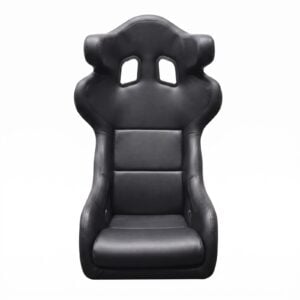
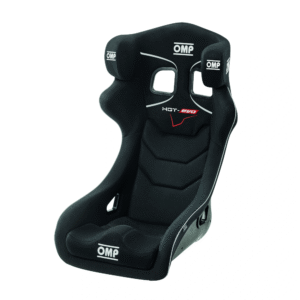
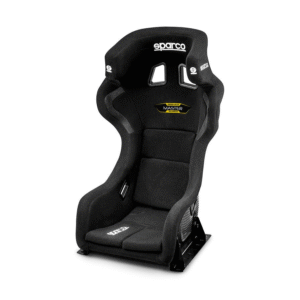
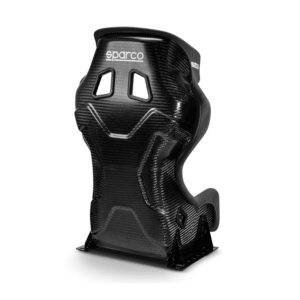
Current head-restraint seat examples
A few different shapes from the live category. Read the standard and mount requirements on each listing.
-
From £486.00 Incl. VATFrom £405.00 Excl. VATPayPal Credit250+ coloursKlarna ReadySelect options This product has multiple variants. The options may be chosen on the product page
-
From £774.60 Incl. VATFrom £645.50 Excl. VATPayPal CreditKlarna ReadySelect options This product has multiple variants. The options may be chosen on the product page



What customers ask about head-restraint seats
What is a head-restraint bucket seat?▾
It is a fixed seat with side supports around the driver’s head as part of the shell. Those supports are intended to help manage lateral movement. The seat still has to fit the pelvis, shoulders and helmet position correctly.
Is a head-restraint seat the same as a HANS device?▾
No. A HANS or other approved FHR is worn by the driver and restrains the head relative to the torso in a frontal impact. The side-head supports on a seat and the FHR do different jobs. Event rules may require both.
Do I need a head-restraint seat for a track day?▾
Not automatically. Check the organiser rules and consider the complete car, including cage, harness, door bars, nets and available cockpit space. A non-competitive track day does not create one universal seat requirement.
Does every head-restraint seat have FIA approval?▾
No. Some are road-and-track or specialist containment seats without the FIA seat label needed by particular competitions. Check the exact model, label, technical-list entry and event regulations.
Which FIA seat standards should I look for?▾
Common current listings include 8855-1999 competition seats, 8855-2021 competition seats and 8862-2009 advanced seats. The championship decides which are accepted. There is no FIA 8882-2009 seat standard; that number on the old guide was an error.
Can I use generic side mounts?▾
Not for every seat. Seats to 8855-2021 and 8862-2009 are homologated with specified supports. Read the technical-list entry and manufacturer instructions before choosing mounts.
How should the head wings fit around my helmet?▾
For 8855-2021 and 8862-2009 seats, FIA guidance sets the seated eyeline within the side-head support area and calls for comfortable support at the pelvis, shoulders and head. Use the exact seat instructions and check clearance in the car.
Can I return a seat after trying it in the car?▾
Ask before ordering, especially for a made-to-order trim. The best option is to sit in showroom stock or send driver and cockpit measurements so we can narrow the choice before a clean new seat is handled or mounted.
Try the whole driving position
Tell Garreth or Cameron the championship, car, cage and driver measurements. We can compare the shell shapes and check the label on the actual seat before you commit.
Browse head-restraint seatsCall 0115 9893488Get directionsBrowse all FIA seats